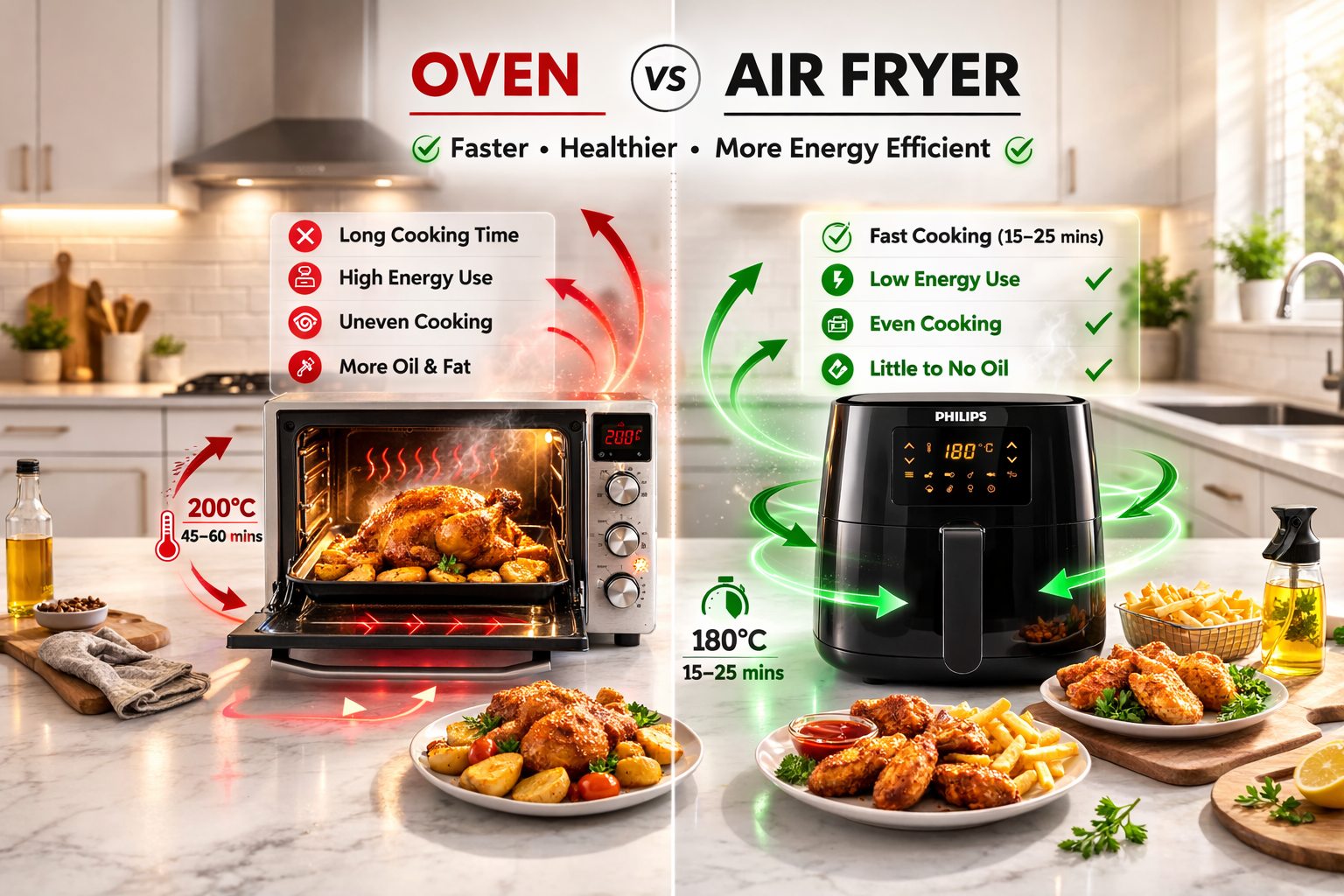
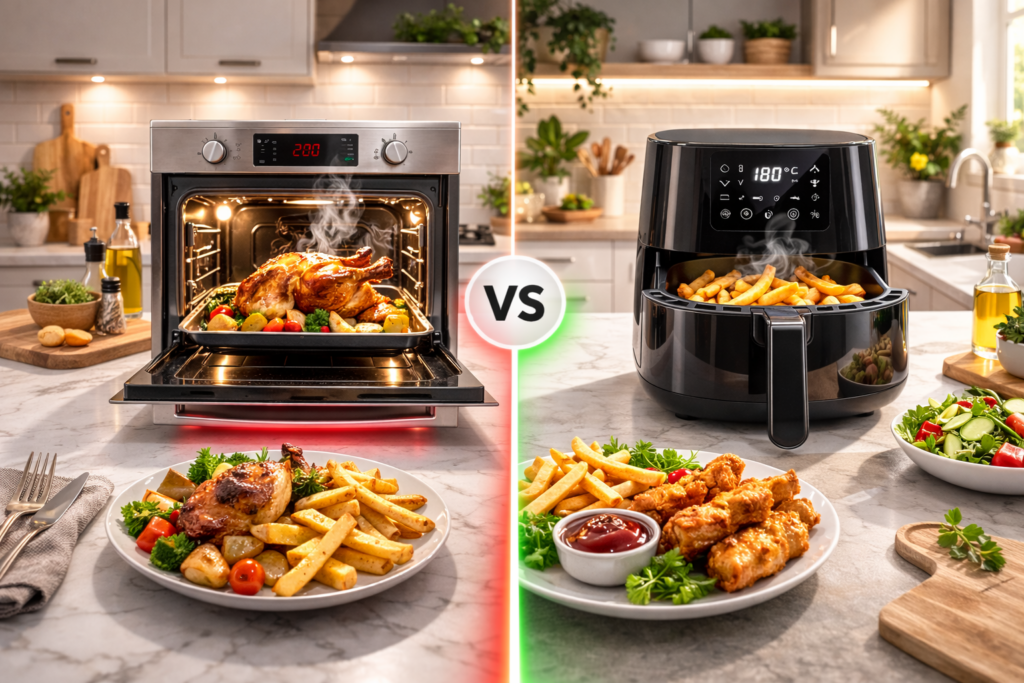
With electricity prices rising and loadshedding still affecting daily life, many South African households are looking for cheaper ways to cook at home. One of the most common questions people ask is whether an air fryer actually uses less electricity than a traditional oven.
Both appliances can cook similar meals, but they operate very differently. In this guide, we compare the real electricity usage of an air fryer vs an oven in South Africa, explain how much each costs to run, and discuss which option is more practical during loadshedding.
For a full buyer comparison and recommended models, read our Best Air Fryer in South Africa guide.
How Much Electricity Does an Oven Use?
A standard electric oven in a South African home generally draws between 2,500W and 3,000W while heating. Before cooking even begins, the oven must preheat, which already consumes a noticeable amount of electricity.
Most meals require 45 minutes to an hour of cooking time, and some dishes need even longer. Because of the high wattage and extended operating time, ovens are among the higher electricity-consuming appliances in the kitchen, especially when used several times a week.
How Much Electricity Does an Air Fryer Use?
Air fryers use a heating element and a high-speed fan to circulate hot air around food. Most models available in South Africa run between about 1,200W and 2,000W depending on size.
Unlike an oven, an air fryer does not need long preheating and usually reaches cooking temperature within a few minutes. Food portions such as chips, chicken strips, and vegetables often cook in 12 to 25 minutes.
Because the cooking time is shorter and the internal space is smaller, the total electricity used per meal is generally lower than that of a traditional oven, even if the air fryer draws similar power while running.
Electricity Cost Comparison (Air Fryer vs Oven in South Africa)
To understand the real difference, it helps to look at electricity usage in practical terms. South African electricity tariffs vary by municipality, but a typical residential rate is roughly around R2.50 to R4.75 per kWh.
A typical oven running at about 2,800W for one hour uses roughly 2.8 kWh of electricity. Depending on the tariff, that single cooking session can cost approximately R7 to R14.
An air fryer using around 1,500W for 20 minutes consumes only about 0.5 kWh. This usually costs about R1.50 to R2.50 per use.
While the exact numbers differ slightly by model and cooking time, the pattern remains consistent: an air fryer generally costs significantly less electricity per meal than a conventional oven.
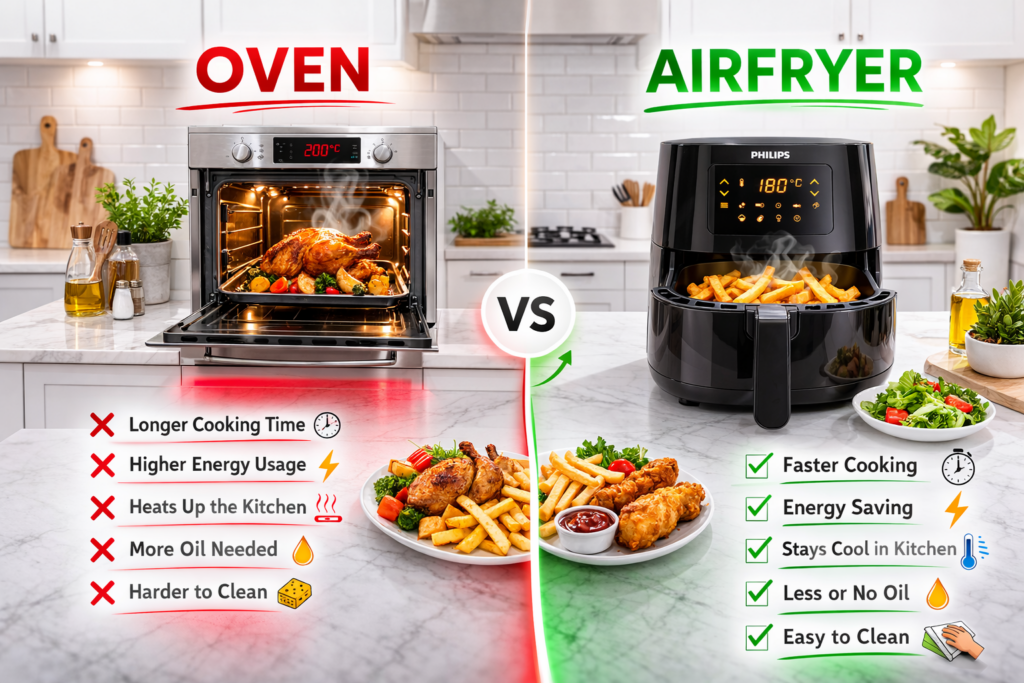
Air Fryer vs Oven Comparison
| Feature | Air Fryer | Oven |
|---|---|---|
| Typical Power Usage | 1200W – 2000W | 2500W – 3000W |
| Preheating Time | Very short (2–5 minutes) | Long (10–20 minutes) |
| Cooking Time | Fast | Slower |
| Electricity Cost per Use | Lower (R1.50-R2.50) | Higher (R7-R14) |
| Works on Backup Power | Sometimes (depending on inverter/generator) | Usually not |
| Best For | Daily meals, small portions | Large meals, baking |
| Loadshedding Practicality | More practical | Less practical |
Air Fryer vs Oven on Backup Power (Inverters & Batteries)
During loadshedding there is no electricity available, so neither an oven nor an air fryer can operate unless a backup power system is being used. Many South African households now rely on inverters or battery systems to keep essential appliances running when power returns or during shorter outages.
A full-sized electric oven usually requires more power than most residential backup systems can safely supply. The heating elements draw high wattage for long periods, which quickly drains batteries or overloads smaller inverters/generators.
An air fryer is generally more practical on backup power. It runs for shorter periods, and, depending on the inverter size, many households can operate it for quick meals after an outage. For homes using battery backup, an air fryer is typically a far more manageable cooking appliance than a traditional oven.
Frequently Asked Questions
Does an air fryer really save electricity compared to an oven?
Yes. Although an air fryer still uses a heating element, it cooks food much faster and in a smaller space. Because of the shorter cooking time, the total electricity used per meal is usually lower than a traditional oven.
Can an air fryer run on an inverter in South Africa?
It depends on the inverter size. Many medium- to large-sized inverters can run smaller or mid-sized air fryers for short cooking periods, but very small backup systems may struggle to handle the starting power draw.
Why does an oven use more power?
An oven heats a much larger internal space and must maintain temperature for a long time. The heating elements repeatedly switch on to keep the temperature steady, which increases electricity consumption.
Is it cheaper to cook chicken in an air fryer?
In most cases yes. Chicken portions usually cook in 18–25 minutes in an air fryer compared to much longer cooking times in an oven, reducing overall energy use.
Which appliance is better after loadshedding?
After power returns, an air fryer is usually more practical because it heats quickly and prepares meals faster. An oven takes longer to preheat and uses more electricity during the same period.
Final Thoughts
For many South African households, an air fryer is not only convenient but also a practical way to reduce cooking electricity costs. While ovens are still useful for large meals and baking, an air fryer offers faster cooking and lower power usage for everyday meals, especially when managing electricity carefully.
Want to know more in-depth about the electricity cost of an air fryer? Please check how much electricity does an air fryer use in south africa (2026)
For more comparisons and buying advice, visit our Air Fryer Guides in South Africa.
Leave a Reply