Tag: electricity saving South Africa

  • How Much Electricity Does a Fridge Use in South Africa? (2026)

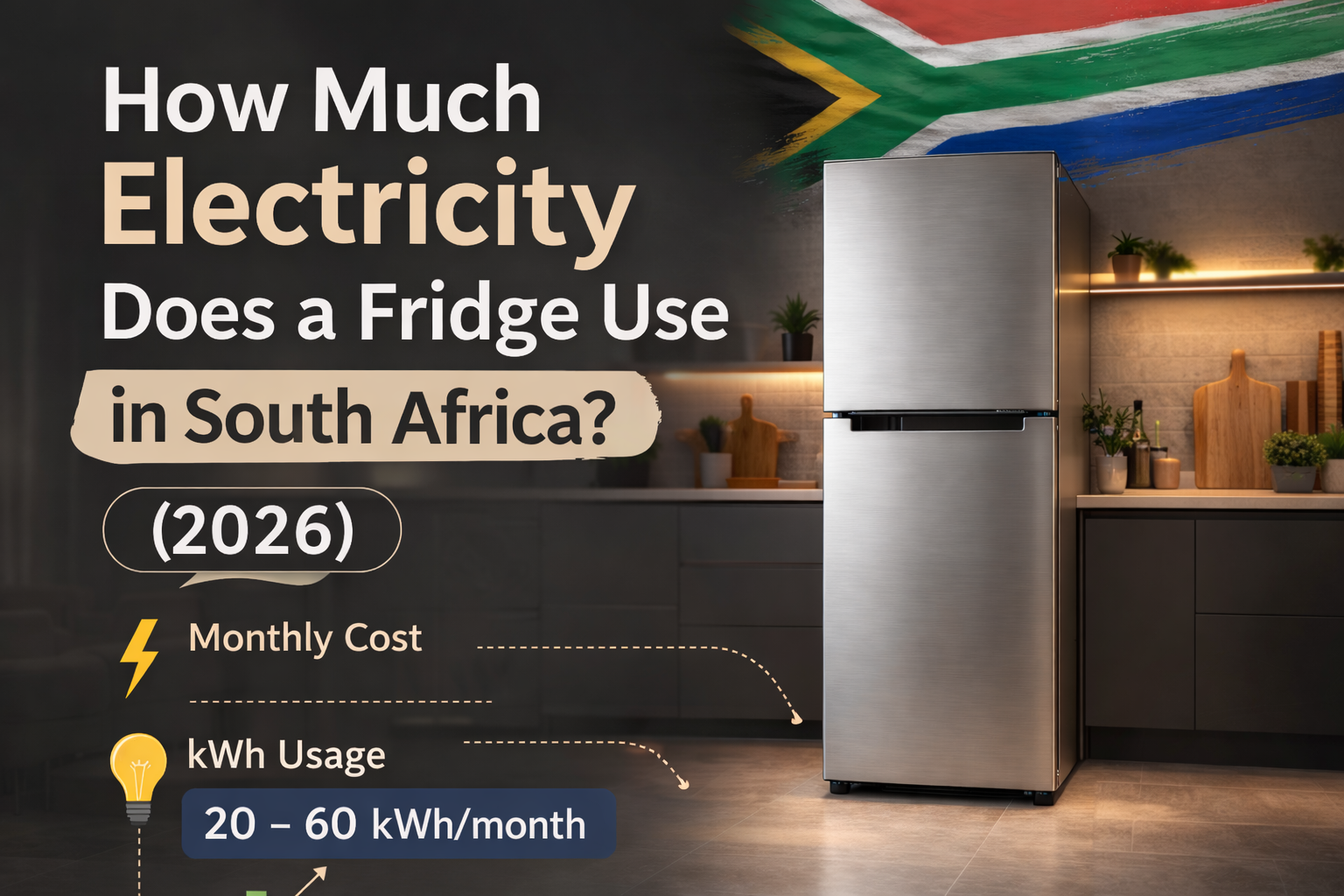
    How Much Electricity Does a Fridge Use in South Africa? (2026)

    Published on Tigdag.com | Updated March 2026

    Your fridge is the one appliance in your home that never switches off. While your kettle, air fryer, and microwave only draw power when you use them, your fridge runs 24 hours a day, 7 days a week — which makes it one of the biggest contributors to your monthly electricity bill.

    With Eskom tariffs continuing to rise in 2026, understanding exactly how much electricity your fridge uses — and how to reduce it — can make a meaningful difference to your household budget. This guide gives you real wattage figures, monthly cost calculations in rands, a comparison of fridge types, and practical tips specific to South African conditions including loadshedding.

    Quick Answer: A typical South African household fridge uses between 100 and 400 kWh per year depending on its size, age, and efficiency rating. At R2.80/kWh, that works out to R280–R1,120 per year — or R23–R93 per month — just to keep your food cold.

    How Much Power Does a Fridge Actually Use?

    Unlike most appliances, fridges do not run at full power continuously. The compressor switches on and off throughout the day to maintain the set temperature. This is called the duty cycle. A typical fridge compressor runs for about 30–50% of the time, which is why the actual electricity consumption is much lower than the peak wattage on the label.

    Fridge TypePeak WattageAvg Running WattsEst. Annual kWhEst. Monthly Cost (R2.80/kWh)
    Small bar fridge (50–100L)80–120W30–50W100–150 kWhR23–R35
    Medium fridge (200–300L)150–200W60–90W150–250 kWhR35–R58
    Large fridge-freezer (350–500L)200–300W90–140W250–400 kWhR58–R93
    Side-by-side (500L+)300–400W130–180W350–500 kWhR82–R117
    Chest freezer (200–300L)100–200W40–80W150–250 kWhR35–R58

    ✅ Tip: The wattage label on your fridge shows peak power draw, not average consumption. Your actual monthly cost is significantly lower because the compressor cycles on and off throughout the day.

    How to Calculate Your Fridge’s Exact Electricity Cost

    The most accurate way to calculate your fridge’s running cost is to use the annual energy consumption figure shown on the energy label — usually displayed in kWh/year on newer models sold in South Africa.

    Step 1: Find the Annual kWh Rating

    Check the energy label on the front or inside door of your fridge. It will show a number like ‘250 kWh/year’. If your fridge does not have this label, use the average figures in the table above based on your fridge size.

    Step 2: Calculate Monthly Cost

    Monthly cost = (Annual kWh ÷ 12) × Your tariff rate (R/kWh)

    Example: A fridge rated at 300 kWh/year at R2.80/kWh:

    300 ÷ 12 = 25 kWh per month × R2.80 = R70 per month

    ✅ Tip: Your municipality tariff may differ from R2.80/kWh. Check your latest Eskom or municipality bill for your exact rate. City Power (Johannesburg), City of Cape Town, and eThekwini (Durban) all charge slightly different rates.

    Fridge Electricity Use by Brand — Common SA Models

    Here is how some of the most popular fridge models available in South Africa compare on electricity usage, based on manufacturer-published energy ratings:

    Brand & ModelCapacityEnergy RatingEst. Annual kWhEst. Monthly Cost
    Samsung RT38 Twin Cooling384LA+~280 kWh~R65
    LG GBV3100DEP341LA++~220 kWh~R51
    Hisense H520BI-WD519LA+~350 kWh~R82
    Defy DFC416408LA~320 kWh~R75
    KIC KTF519519LB~420 kWh~R98
    Bosch KGN39VLEAG366LA++~195 kWh~R45
    Russell Hobbs RH6WDF246L bar fridgeA+~100 kWh~R23

    Note: Energy consumption figures are based on manufacturer specifications under standardised test conditions. Real-world usage may vary based on ambient temperature, how often the door is opened, and how full the fridge is.

    How Fridge Energy Ratings Work in South Africa

    Fridges sold in South Africa are rated on a scale from A+++ (most efficient) down to G (least efficient). This system follows the European energy labelling standard which most SA retailers use.

    Energy RatingEfficiency LevelWhat It Means for Your Bill
    A+++Highest efficiencyUses up to 60% less electricity than older models
    A++Very high efficiencyExcellent long-term saving, worth the higher purchase price
    A+High efficiencyGood choice for most households
    AEfficientAcceptable — common in mid-range SA models
    BBelow averageNoticeably higher running costs over time
    C–GPoor efficiencyAvoid for new purchases — significantly higher bills

    ✅ Tip: An A+++ fridge may cost R500–R1,500 more to buy than a B-rated model, but can save you R300–R600 per year on electricity. Over 10 years, the energy saving pays for the price difference many times over.

    How Loadshedding Affects Your Fridge

    Loadshedding creates a unique challenge for South African households that most international guides do not address. Here is what actually happens to your fridge during a power outage and what you should do about it.

    How Long Does a Fridge Stay Cold During Loadshedding?

    ApplianceStays Cold ForCondition
    Full fridge4–6 hoursDoor kept closed
    Half-full fridge2–4 hoursDoor kept closed
    Full chest freezer24–48 hoursDoor kept closed
    Upright freezer (full)12–24 hoursDoor kept closed
    Bar fridge2–3 hoursDoor kept closed

    ⚡ Loadshedding Note: The single most important rule during loadshedding is to keep your fridge and freezer doors closed as much as possible. Every time you open the door, cold air escapes and warm air enters, reducing how long food stays safe.

    Food Safety During Loadshedding

    • Fridge food (above 4°C for more than 4 hours): discard dairy, meat, fish, cooked foods, and eggs if unsure
    • Frozen food that still has ice crystals: safe to refreeze or cook immediately
    • Frozen food that has fully thawed: cook immediately, do not refreeze
    • Keep a thermometer in your fridge — food is safe below 4°C
    • Group fridge items together when loadshedding starts to retain cold mass

    Running a Fridge on Backup Power

    Many South African households ask whether they can run their fridge on an inverter or generator during loadshedding. The answer is yes, but with important considerations:

    Backup Power TypeCan It Run a Fridge?What You Need
    Home inverter (2kVA+)Yes, for most medium fridgesInverter must handle startup surge (2–3x running watts)
    Home inverter (1kVA)Bar fridge onlyNot suitable for full-size fridges
    Mini UPSNoMini UPS units are too small for fridge compressors
    Petrol generator (2kVA+)YesAllow generator to stabilise first
    Solar with battery bankYes, if properly sizedBattery must handle overnight running

    ✅ Tip: The startup surge of a fridge compressor is typically 3–5 times its running wattage. A fridge that runs at 90W may draw 400–500W for the 1–2 seconds when the compressor starts. Your inverter must be rated to handle this surge.

    Tips to Reduce Your Fridge’s Electricity Usage

    Because your fridge runs continuously, even small efficiency improvements compound into significant savings over a year. These tips are practical for South African conditions:

    Temperature Settings

    • Set your fridge to 3–5°C — colder than this wastes electricity without improving food safety
    • Set your freezer to -18°C — colder than this significantly increases running costs with no benefit
    • Every 1°C colder than necessary increases electricity use by approximately 5%

    Placement and Ventilation

    • Keep your fridge away from direct sunlight and heat sources like ovens and stoves
    • Leave at least 5cm of space behind and on the sides of your fridge for ventilation
    • In hot SA summers, a poorly placed fridge in a warm kitchen can use up to 30% more electricity

    Door and Seal Maintenance

    • Check door seals regularly — place a R5 coin between the door and seal, close the door, and try to pull it out. If it slides out easily, your seal needs replacing
    • Clean door seals with warm water every few months to prevent hardening and cracking
    • Do not leave the fridge door open longer than necessary — especially important in summer

    Loading and Usage

    • A full fridge is more efficient than an empty one — the cold mass of food helps maintain temperature
    • Allow hot food to cool to room temperature before placing it in the fridge
    • Defrost your freezer regularly if it is not frost-free — ice buildup thicker than 5mm increases electricity use significantly
    • Clean the coils at the back of older fridges annually — dust buildup forces the compressor to work harder

    When to Replace Your Old Fridge

    One of the biggest electricity savings available to South African households is replacing an old, inefficient fridge with a modern energy-efficient model. Here is how to know when the time is right:

    Fridge AgeTypical Efficiency vs NewRecommendation
    0–5 yearsComparable to new modelsKeep — maintain it well
    5–10 years10–20% less efficientMonitor running costs, plan replacement
    10–15 years20–40% less efficientConsider replacing if electricity bill is a concern
    15+ years40–60% less efficientReplace — you are likely spending R400–R600 extra per year

    ✅ Tip: If your fridge is more than 15 years old, replacing it with an A++ or A+++ rated model will likely save you more money in electricity over 5 years than the cost of the new fridge. This is especially true with South Africa’s rapidly rising tariffs.

    Fridge vs Other Kitchen Appliances — Monthly Cost Comparison

    To put your fridge’s electricity use in context, here is how it compares to other common kitchen appliances in a typical South African home:

    ApplianceUsage PatternEst. Monthly Cost (R2.80/kWh)
    Fridge-freezer (350L, A+)24/7R58–R82
    Electric geyser (150L)2–3 hours/dayR180–R280
    Electric oven1 hour/dayR84–R100
    Air fryer (1,600W)30 min/dayR25–R42
    Kettle (2,000W)10 min/day x 4 cupsR19–R28
    Microwave (1,000W)15 min/dayR12–R18
    LED TV (100W)5 hours/dayR42

    The data shows that your fridge is a significant but not the largest electricity user in most homes. The electric geyser (water heater) is typically the single biggest electricity cost for South African households, often accounting for 30–40% of a monthly bill.

    Frequently Asked Questions

    How much does it cost to run a fridge per day in South Africa?

    A medium fridge-freezer (300L, A+ rated) uses approximately 0.6–0.8 kWh per day. At R2.80/kWh, that is R1.68–R2.24 per day. A larger or older fridge may cost R3–R4 per day to run.

    Does opening the fridge frequently increase electricity usage?

    Yes. Every time you open the fridge door, warm air enters and the compressor must work to cool the air back down. In a busy household, frequent door opening can increase fridge electricity use by 10–15%. In summer, this effect is more pronounced because the incoming air is warmer.

    Is it cheaper to keep the fridge full or empty?

    Full is more efficient. Food and drinks act as thermal mass — they store cold and help maintain temperature when the door is opened. An empty fridge loses its cold air quickly every time the door opens. If your fridge is frequently empty, keep a few bottles of water in it to maintain thermal mass.

    Should I switch off my fridge during loadshedding?

    No. Do not switch off your fridge manually during loadshedding. The power will cut automatically and return automatically. Switching it off and on manually creates unnecessary compressor stress. Simply leave it alone and keep the door closed.

    How do I know if my old fridge is costing me too much to run?

    Compare your electricity bill from a month with heavy fridge use (summer) versus a cooler month. If you notice a large difference, your fridge may be working harder than it should. You can also use a plug-in energy monitor (available from Builders Warehouse and Makro) to measure exactly how many kWh your fridge uses per day.

    Can a fridge run on solar power in South Africa?

    Yes. A properly sized solar system with battery storage can run a fridge continuously, including overnight. A medium fridge drawing 60–90W continuously needs a battery bank of at least 100Ah at 12V (or equivalent) to run through an 8-hour loadshedding window. Consult a solar installer for a properly sized system.

    Final Verdict

    Your fridge is one of the most consistent electricity users in your home, but it is also one of the easiest to optimise. Simple habits — setting the right temperature, keeping the seals in good condition, not leaving the door open, and keeping it well-stocked — can reduce your fridge’s electricity use by 15–25% without spending a cent.

    If your fridge is more than 10 years old, replacing it with a modern A++ or A+++ rated model is one of the best investments you can make against rising South African electricity tariffs. The savings compound year after year as Eskom prices continue to increase.

    For South African households dealing with loadshedding, keeping the freezer well-stocked and the fridge door firmly closed during outages is the most practical way to protect your food and reduce waste.

    Related guides on Tigdag.com:

    Tigdag is a South African buying guide and product review website. All content is written to give practical, real-world advice for South African households — not generic international content repurposed for a local audience.

  • How Much Electricity Does an Air Fryer Use in South Africa? (2026 Real Cost Guide)

    How Much Electricity Does an Air Fryer Use in South Africa? (2026 Real Cost Guide)

    Published on Tigdag.com | Updated March 2026

    Air fryers have become one of the most popular kitchen appliances in South Africa — and for good reason. They cook faster than an oven, require little oil, and work on many inverter systems during loadshedding. But one of the most common questions South Africans ask before buying is: how much electricity does an air fryer actually use, and what will it cost me every month?

    This guide gives you real wattage figures, cost calculations based on South African Eskom tariffs, and a direct comparison against other common kitchen appliances so you can make an informed decision.

    Quick Answer: A typical air fryer uses between 1,200W and 2,000W. At South Africa’s average electricity rate of around R2.80 per kWh (2026), a 30-minute cooking session costs approximately R0.70 to R1.40. Over a full month of daily use, that works out to R21–R42 — significantly less than a traditional oven.

    How Many Watts Does an Air Fryer Use?

    Air fryers vary in wattage depending on their size and brand. Here is a breakdown of the most common air fryer types available in South Africa and how much power they draw:

    Air Fryer SizeTypical WattageBest For
    Small (2–3L)1,200W – 1,500W1–2 people, inverter use, small kitchens
    Medium (4–6L)1,500W – 1,800W2–4 people, most households
    Large (6L+)1,800W – 2,200WFamilies, large meals
    Dual basket models2,000W – 2,400WFamilies cooking multiple dishes

    💡 Lower wattage does not always mean slower cooking. A well-designed 1,500W air fryer with good airflow can outperform a poorly designed 2,000W model.

    What Does It Cost to Run an Air Fryer in South Africa?

    South African electricity tariffs vary by municipality. As a general reference, the average residential rate in Johannesburg, Cape Town, and Durban sits between R2.60 and R3.10 per kWh in 2026. For this guide we use R2.80/kWh as the baseline.

    The formula for calculating your electricity cost is straightforward:

    Cost = (Wattage ÷ 1,000) × Hours Used × Tariff Rate

    Air FryerWattage30-min session1 hourMonthly (daily use, 30 min)
    Small (1,200W)1,200WR0.84R1.68R25.20
    Medium (1,600W)1,600WR1.12R2.24R33.60
    Large (2,000W)2,000WR1.40R2.80R42.00

    💡 These figures assume daily use. Most households cook with an air fryer 4–5 times per week, so your real monthly cost is likely 20–30% lower than the figures above.

    Air Fryer vs Oven vs Microwave — Electricity Comparison

    To understand whether an air fryer is worth it, it helps to compare it against the appliances most South Africans already own:

    ApplianceWattageAvg Cook TimeCost per Meal (R2.80/kWh)
    Electric oven2,500W – 3,000W45–60 minR5.25 – R8.40
    Air fryer (medium)1,600W18–25 minR1.20 – R1.87
    Microwave800W – 1,200W5–10 minR0.19 – R0.56
    Stove plate (electric)1,500W – 2,000W20–30 minR1.40 – R2.80

    The data shows that an air fryer is not the cheapest appliance per minute of use — a microwave is — but when you factor in that an air fryer replaces an oven for most cooking tasks, the savings are significant. Switching from an oven to an air fryer for daily meals can save South African households R80–R150 per month on electricity.

    Can You Run an Air Fryer During Loadshedding?

    This is one of the most searched questions on the topic in South Africa, and the answer depends entirely on your backup power setup.

    Inverter + Battery System

    Most medium to large home inverters (2kVA and above) can run a small to medium air fryer. The key consideration is the air fryer’s startup surge — most models draw slightly more current at startup than during steady operation.

    • 1,200W air fryer → needs at least a 1.5kVA inverter (2kVA recommended)
    • 1,600W air fryer → needs at least a 2kVA inverter
    • 2,000W+ air fryer → needs a 3kVA or larger inverter

    💡 Always check your inverter’s continuous watt rating, not just its peak rating. The air fryer must run within the continuous watt capacity.

    Solar Systems

    If your solar system includes a battery bank, an air fryer is viable during loadshedding as long as the battery is sufficiently charged. A 30-minute air fryer session at 1,600W uses 0.8kWh — roughly the equivalent of running an LED TV for 8 hours.

    Generator

    Most petrol generators of 2kW or higher will run an air fryer without difficulty. Always allow the generator to stabilise before switching on the air fryer.

    Which Air Fryers Use the Least Electricity in South Africa?

    If electricity saving is your primary concern, here are the most efficient options available in South Africa:

    ModelWattageCapacityEstimated Monthly Cost*
    Xiaomi Mi Smart Air Fryer 3.5L1,500W3.5LR31.50
    Philips Essential Air Fryer 4.1L1,400W4.1LR29.40
    Russell Hobbs Satisfry 4L1,350W4LR28.35
    Bennett Read 4L Digital1,600W4LR33.60

    *Based on 30-minute daily use at R2.80/kWh

    Tips to Reduce Air Fryer Electricity Usage

    Even small changes in how you use your air fryer can reduce your electricity costs:

    • Preheat for 2–3 minutes only — air fryers heat faster than ovens and do not need long preheating
    • Avoid overcrowding the basket — food cooks faster and more evenly when air can circulate freely
    • Use the right temperature — higher is not always better; cooking at the correct temperature reduces wasted energy
    • Cook in batches — if you are preparing multiple items, cook them back to back while the air fryer is already hot
    • Keep the basket clean — residue buildup reduces efficiency over time
    • Use a smaller air fryer if cooking for 1–2 people — larger models use more energy even when not full

    Frequently Asked Questions

    Does an air fryer use more electricity than a microwave?

    Yes. A microwave typically uses 800W–1,200W and cooks food in 5–10 minutes, making it the most energy-efficient cooking appliance. However, an air fryer produces different cooking results — crispier textures — that a microwave cannot replicate. For reheating, a microwave is cheaper. For roasting, grilling, or making crispy chips, an air fryer is more efficient than an oven.

    How much does it cost to run an air fryer for 1 hour in South Africa?

    At R2.80/kWh, a 1,600W air fryer costs approximately R4.48 per hour. In practice, very few recipes require a full hour, so most cooking sessions cost between R1.00 and R2.50.

    Is an air fryer cheaper to run than an oven in South Africa?

    Yes, significantly. A standard electric oven uses 2,500W–3,000W and typically requires 45–60 minutes for a full meal including preheat time. An air fryer doing the same job uses 1,200W–2,000W and typically completes cooking in 18–25 minutes. The total energy used is 60–70% less per meal in most cases.

    Will an air fryer increase my electricity bill noticeably?

    Not significantly, especially if it replaces your oven. If you are adding air frying on top of existing cooking habits, expect to add R25–R45 to your monthly electricity bill. If you use it instead of your oven, you are likely to see your bill decrease.

    Final Verdict

    An air fryer is one of the most electrically efficient cooking appliances you can own in South Africa, particularly when compared to a traditional oven. For households dealing with loadshedding and rising electricity tariffs, a small- to medium-sized air fryer offers a practical way to cook full meals quickly and cost-effectively.

    The key is choosing the right size for your household. A family of four does not need a 2,200W dual-basket model if a 1,600W medium air fryer will handle daily cooking. Matching size to actual need is the single most effective way to manage air fryer electricity costs.

    Related guides on Tigdag.com:

    Tigdag is a South African product review website focused on helping households choose practical appliances. All guides are written to simplify buying decisions and explain real-world usage rather than marketing claims. No sponsored rankings.

  • Best Air Fryer in South Africa (2026)— Complete Buyer’s Guide

    Best Air Fryer in South Africa (2026)— Complete Buyer’s Guide

    Loadshedding has changed the way South Africans cook at home, and air fryers have quickly become one of the most popular kitchen appliances because they use less electricity than ovens while cooking food faster. The problem is that many people buy the wrong size or a low-quality model and end up with uneven cooking, long cooking times, or a unit that trips an inverter during power outages.

    In this guide we compare the best air fryers available in South Africa in 2026, explain what size you actually need, how much power they use, and which models work best during loadshedding so you can choose the right one the first time.

    Quick Answer: The Best Air Fryers in South Africa (2026)

    If you don’t want to read the full guide, these are the top air fryer choices in South Africa right now based on reliability, cooking performance, electricity usage and value for money:

    • Best Overall: Philips Essential XL Air Fryer
    • Best Budget Option: Bennett Read 4L Digital Air Fryer
    • Best for Large Families: Milex XXXL 7.2L Air Fryer
    • Best for Loadshedding/Inverter Use: Xiaomi Smart Air Fryer 3.5L

    Below we explain why these models stand out and which one is right for your home.

    1. Philips Essential XL Air Fryer – Best Overall Air Fryer in South Africa

    Philips Essential XL Air Fryer South Africa

    The Philips Essential XL Air Fryer is one of the most popular air fryers in South Africa and for good reason. It uses Rapid Air Technology to circulate hot air evenly around food, producing crispy results with little to no oil. The 6.2L capacity is large enough for a family of 4 and makes it ideal for chips, chicken, and frozen foods during loadshedding.

    This model is especially attractive to first-time buyers because it is simple to use, heats up quickly, and is far more electricity efficient than a traditional oven. For households affected by frequent loadshedding, the lower power usage makes a noticeable difference on inverter or backup power systems.

    Key Features

    • ±6.2L capacity (3-4 people: small family size)
    • Rapid Air Technology for even cooking
    • Adjustable temperature control
    • Timer with automatic shut-off
    • Non-stick removable basket
    • Easy manual controls

    Pros

    • Very easy to use
    • Energy efficient
    • Even cooking results
    • Good size for families
    • Trusted Philips reliability

    Cons

    • More expensive than budget brands
    • No viewing window
    • Basic digital display

    Who should buy the Philips Essential XL Air Fryer?

    • Live in a flat or small house
    • Want to reduce electricity usage during loadshedding
    • Cook for 3-4 people
    • Want fast meals after work
    • Ideal for beginners who don’t want complicated settings

    2. Milex Power Air Fryer XXL – Best Budget Air Fryer in South Africa

    Bennett Read 7.5L Digital Air Fryer South Africa

    Many South Africans want an air fryer but don’t want to spend premium prices. The Milex Power Air Fryer XXL is one of the most popular budget air fryers because it offers a large basket and strong performance at a much lower price than premium brands.

    It is especially popular for students, small families, and first-time buyers who want to try air frying without committing to an expensive appliance.

    Key Features

    • ±5.6L capacity (good for 3–4 people)
    • Adjustable temperature control
    • 30-minute timer
    • Non-stick removable basket
    • Manual dial operation (very simple controls)

    Pros

    • Very affordable compared to premium brands
    • Large basket for the price
    • Easy to operate
    • Good results with frozen foods
    • Widely available in South Africa

    Cons

    • Build quality is average
    • Louder fan noise than premium air fryers
    • No automatic cooking programs
    • Can cook unevenly if basket is overcrowded

    Who should buy this air fryer?

    The Milex Power Air Fryer XXL is ideal for first-time buyers, students, or households on a budget that still want to reduce electricity usage and cook during loadshedding recovery periods. It offers excellent value for money and is a good starting point before upgrading to a premium model later.

    Bennett Read 7.5L Digital Air Fryer – Best for Large Families

    Bennett Read 7.5L Digital Air Fryer South Africa

    For bigger households, basket size becomes very important. The Bennett Read 7.5 L Digital Air Fryer is a popular choice in South Africa because it offers a much larger cooking capacity than standard air fryers while still remaining affordable.

    The 7.5-litre basket allows you to cook multiple portions at once, making it useful for families who want to prepare meals quickly without cooking in batches. This is especially helpful during loadshedding recovery periods when electricity is available for a short time and meals need to be prepared fast.

    Unlike manual dial air fryers, this model includes digital controls and preset cooking programs, which makes it easier for beginners to get consistent cooking results.

    Key Features

    • Large 7.5L capacity (4-6 people: family sized)
    • Digital touch screen controls
    • Multiple cooking presets
    • Adjustable temperature control
    • Timer with automatic shut-off

    Pros

    • Large cooking capacity
    • Easy digital controls
    • Good for families
    • Faster meal preparation
    • Good value for its size

    Cons

    • Takes more counter space
    • Uses slightly more electricity than smaller models
    • Not ideal for very small kitchens

    Who should buy this air fryer?

    The Bennett Read 7.5L Digital Air Fryer is best suited for families of four or more people or households that cook larger meals. It is particularly useful for preparing full dinners quickly during loadshedding breaks.

    Xiaomi Mi Smart Air Fryer 3.5L – Best for Small Homes & Inverter Use

    Xiaomi Mi Smart Air Fryer 3.5L South Africa

    The Xiaomi Mi Smart Air Fryer 3.5L has become very popular in South Africa because it combines compact size with modern smart features. Unlike traditional air fryers, this model connects to a mobile app, allowing you to schedule cooking, adjust temperature, and monitor cooking progress remotely.

    Its smaller capacity makes it ideal for couples, flats, and apartments where kitchen space is limited. Another advantage is its lower power draw compared to larger air fryers, which makes it one of the more practical options for households using backup batteries or certain inverters during loadshedding recovery periods.

    The digital temperature control also allows slower cooking at lower heat settings, which is useful for reheating food, baking, or dehydrating snacks.

    Key Features

    • 3.5L compact capacity (1-2 people)
    • App control via smartphone
    • Digital temperature control
    • Timer scheduling
    • Sleek modern design

    Pros

    • Compact and space-saving
    • Lower electricity usage than large models
    • Smart app features
    • Quiet operation
    • Good for couples or small kitchens

    Cons

    • Small basket size
    • Not suitable for large families
    • Higher price than basic budget models

    Who should buy this air fryer?

    The Xiaomi Mi Smart Air Fryer is ideal for couples, apartment living, and people who want a modern appliance with smart features. It is also a practical choice for households that rely on backup power because of its smaller energy demand.

    Air Fryer Comparison Table (South Africa)

    ModelCapacityPower UsageBest ForPrice Range
    Philips Essential XL6.2L±2000WOverall performancePremium
    Milex Power Air Fryer XXL5.6L±1700WBudget buyersAffordable
    Bennett Read 7L Digital7.5L±1800WFamiliesMid-range
    Xiaomi Mi Smart Air Fryer3.5L±1500WSmall homes & inverter useMid-range

    Note: Air fryer capacity ratings differ between brands. Basket shape and cooking surface area often matter more than the litre number, so two air fryers with similar litre ratings may not cook the same amount of food.

    How to Choose the Right Air Fryer in South Africa

    Choosing the right air fryer is not only about brand name or price. South African households have unique needs because of rising electricity costs and loadshedding, so it is important to consider a few key factors before buying.if you want to rad more about the top brands in SOuth Africa follow click on the link: What Is the Best Air Fryer Brand in South Africa? (2026)

    1. Basket Size

    Air fryer capacity is one of the most important decisions.

    • 2–3L → Suitable for 1 person
    • 3–5L → Couples or small families
    • 5–7L → Families (recommended for most households)

    A larger basket allows you to cook full meals at once instead of cooking in batches.

    2. Electricity Usage

    Power consumption matters, especially if you use backup power.
    Most air fryers use between 1200W and 2000W.

    Smaller air fryers:
    • Use less electricity
    • Work better with inverters

    Large air fryers:
    • Cook more food
    • Use slightly more power

    3. Manual vs Digital Controls

    Manual dial air fryers:
    • Cheaper
    • Simple to operate
    • Reliable

    Digital air fryers:
    • Preset cooking modes
    • More precise temperature control
    • Easier for beginners

    4. Cooking Performance

    Good air fryers should:
    • Heat quickly
    • Cook evenly
    • Produce crispy results

    A stronger fan and proper airflow design are more important than just high wattage.

    5. Cleaning and Maintenance

    Look for:
    • Non-stick basket
    • Dishwasher-safe parts
    • Removable tray

    This makes daily use far easier.

    6. Loadshedding & Backup Power

    Many South Africans specifically buy air fryers to cook after loadshedding.

    Smaller or mid-size air fryers are usually better for inverter systems because they draw less peak power than ovens.

    Air Fryer vs Oven – Which is cheaper in South Africa?

    Many South African households are switching to air fryers because of rising electricity costs and loadshedding. While both an oven and an air fryer can cook similar foods, they do not use the same amount of electricity.

    A traditional electric oven normally uses between 2,500W and 3,000W and also needs time to preheat before cooking starts. An air fryer, on the other hand, usually uses 1,200W to 2,000W and begins cooking immediately without preheating. Because cooking times are shorter, the total electricity used per meal is often much lower with an air fryer.

    For example, chicken pieces may take 45–60 minutes in an oven, but only about 18–25 minutes in an air fryer. Even though the air fryer still draws power, it runs for a much shorter time, which reduces overall energy usage and monthly electricity costs.

    Air fryers are also more practical during loadshedding. Many medium to large inverters can run an air fryer, while most cannot handle a full-size oven. This makes an air fryer a useful option for households using backup power systems.

    Overall, for small to medium meals, an air fryer is usually the cheaper and more practical option compared to a traditional oven in South Africa.

    Frequently Asked Questions About Air Fryers in South Africa

    Does an air fryer use a lot of electricity?
    No. Most air fryers use between 1200W and 2000W. Because they cook faster than an oven, the total electricity used per meal is usually lower.

    Can you run an air fryer during loadshedding?
    You cannot use it during a power outage, but you can use it on certain backup systems. Medium to large inverters can run many air fryers once power returns, depending on the inverter capacity.

    Can an air fryer run on an inverter?
    Yes, but you usually need at least a 2kW inverter depending on the model.

    How long does an air fryer last?
    Most good brands last 3–5 years with normal use.

    Is an air fryer worth it in South Africa?
    Yes, especially because of loadshedding and rising electricity costs.

    Is an air fryer worth it in South Africa?
    Yes, especially because of loadshedding and rising electricity costs.

    What size air fryer do I need?
    A 3–5L air fryer is suitable for 1–2 people, while a 5–7L air fryer is better for families.

    Final Verdict – Is an Air Fryer Worth Buying in South Africa?

    Air fryers have become one of the most practical kitchen appliances for South African households. They cook food faster than an oven, use less electricity, and are especially useful after loadshedding when you need to prepare meals quickly.

    For most homes, a mid-size air fryer is a good investment because it reduces cooking time and monthly electricity usage while still producing crispy results. Whether you choose a premium model like the Philips, a budget option like the Milex, or a larger family unit, an air fryer is a convenient and cost-effective appliance for everyday cooking in South Africa. Check out: Air fryer vs Oven electricity.

    About the author: Tigdag is a South African product review website focused on helping households choose practical appliances for everyday use, especially in situations affected by loadshedding and rising electricity costs. All guides are written to simplify buying decisions and explain real-world usage rather than marketing claims.

    Helpful Guides About Air Fryer Electricity & Loadshedding