Published on Tigdag.com | Updated March 2026
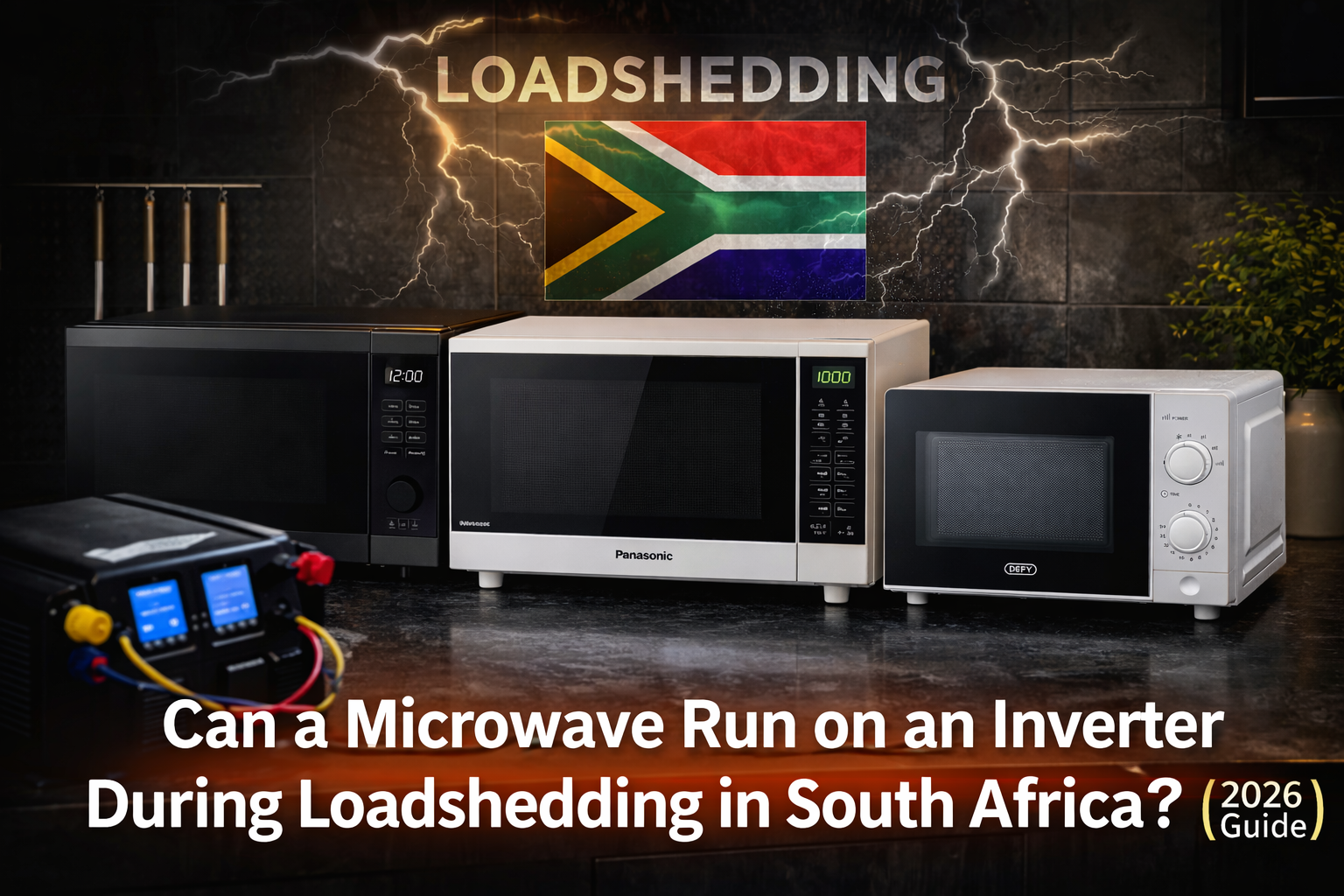
Loadshedding has forced South African households to rethink how they cook. Air fryers, kettles, and microwaves are among the most used kitchen appliances — but not all of them behave the same way on backup power. While an air fryer can run on a 2kVA inverter with reasonable battery life, a microwave is a different story.
This guide explains exactly whether a microwave can run on an inverter during loadshedding in South Africa, what size inverter you actually need, how long your battery will last, and what alternatives are worth considering when the power goes out.
Quick Answer: Yes, a microwave can run on an inverter during loadshedding — but you need a minimum 2kVA pure sine wave inverter, and realistically a 3kVA system for reliable performance. Most small home inverters and all mini UPS devices cannot run a microwave. Battery life is also very short — typically 5–15 minutes of cooking per session depending on your battery bank size.
How Much Power Does a Microwave Actually Use?
Understanding why microwaves are demanding on inverters starts with their power draw. Unlike an air fryer which cycles its heating element on and off, a microwave transformer draws consistent high current from the moment it starts cooking until it stops. There is very little cycling — it runs at full load continuously.
| Microwave Type | Input Wattage (Wall Draw) | Output Wattage (Cooking Power) | Startup Surge |
| 700W output microwave | ~1,000–1,100W input | 700W cooking | 1,500–2,000W for 1–2 seconds |
| 900W output microwave | ~1,200–1,400W input | 900W cooking | 1,800–2,500W for 1–2 seconds |
| 1,000W output microwave | ~1,300–1,500W input | 1,000W cooking | 2,000–3,000W for 1–2 seconds |
| 1,200W output microwave | ~1,600–1,800W input | 1,200W cooking | 2,500–3,500W for 1–2 seconds |
The important distinction is between output wattage (the cooking power advertised on the box) and input wattage (what the microwave actually draws from your wall socket or inverter). A microwave rated at 700W cooking power typically draws 1,000–1,100W from the mains. This is the figure your inverter must handle — not the advertised output wattage.
⚠️ Important: Many South Africans size their inverter based on the advertised cooking wattage on the microwave box. This is incorrect. Always use the input wattage — found on the back label of the microwave — to size your inverter correctly.
What Size Inverter Do You Need to Run a Microwave?
Inverters are rated by their continuous output in VA (volt-amperes) or watts. To run a microwave reliably, your inverter must handle both the continuous input wattage AND the startup surge without tripping or shutting down.
| Inverter Size | Can It Run a Microwave? | Which Microwaves | Notes |
| Mini UPS (300–600VA) | No | None | Far too small — designed for routers only |
| 1kVA inverter (600–800W) | No | None | Cannot handle startup surge of any microwave |
| 1.5kVA inverter (900–1,200W) | Marginal | 700W output only | May trip on startup — not recommended |
| 2kVA inverter (1,200–1,600W) | Yes — with caution | 700W–900W output | Must be pure sine wave, good battery needed |
| 3kVA inverter (1,800–2,400W) | Yes — reliable | 700W–1,000W output | Recommended minimum for reliable microwave use |
| 5kVA inverter (3,000–4,000W) | Yes — comfortably | All microwave sizes | Handles startup surge with ease |
⚠️ Important: Your inverter MUST be a pure sine wave inverter to run a microwave. Modified sine wave inverters (common in cheaper trolley units) will damage microwave transformers over time and may cause the microwave to malfunction immediately. Always confirm your inverter type before connecting a microwave.
✅ Tip: Check the label on the back or bottom of your microwave for the input wattage — it is listed as ‘Input Power’ or ‘Rated Input’. This is the number to use when sizing your inverter, not the output wattage on the front panel.
How Long Will Your Battery Last Running a Microwave?
This is where most South African households get disappointed. Even with the right inverter, microwave cooking sessions on battery power are short. Here is how long common battery configurations will run a 900W input microwave (approximately 700W output):
| Battery Bank | Usable Capacity | Estimated Microwave Runtime | Practical Reality |
| 1 x 100Ah 12V AGM battery | ~50Ah usable (50%) | ~5–7 minutes | One reheating session only |
| 2 x 100Ah 12V AGM batteries | ~100Ah usable | ~10–14 minutes | Two short cooking sessions |
| 1 x 100Ah 12V Lithium (LiFePO4) | ~90Ah usable (90%) | ~9–12 minutes | Better than AGM — more usable capacity |
| 2 x 100Ah 12V Lithium | ~180Ah usable | ~18–25 minutes | Practical for regular loadshedding cooking |
| 100Ah 24V Lithium system | ~180Ah usable (higher voltage) | ~20–28 minutes | More efficient at higher voltage |
The short battery life is the core reason why an air fryer is often a more practical loadshedding cooking appliance than a microwave for most South African households. An air fryer draws similar input wattage to a microwave but produces full cooked meals — not just reheated food — making each battery amp-hour more useful.
✅ Tip: If loadshedding cooking is your priority, a 1,500W air fryer on a 2kVA inverter will give you approximately 30–40 minutes of cooking time on a 100Ah lithium battery — enough for a full meal. A microwave on the same battery gives you 10–12 minutes of reheating only.
Why Your Inverter Must Be Pure Sine Wave
This is one of the most important technical points for South African households running appliances on backup power. There are two types of inverter output:
Pure Sine Wave Inverters
- Produce smooth, consistent AC power — identical to Eskom grid power
- Safe for all appliances including microwaves, fridges, and electronics
- More expensive than modified sine wave inverters
- Examples: Victron, Sunsynk, Deye, Mecer hybrid inverters
Modified Sine Wave Inverters
- Produce a stepped, approximate AC waveform — not smooth
- Cheaper but not suitable for microwave transformers
- Will cause humming, overheating, and eventual transformer damage in microwaves
- Suitable only for basic loads like lights, phone chargers, and fans
- Common in cheap trolley inverters sold under R2,000 at hardware stores
⚠️ Important: If you are unsure whether your inverter is pure sine wave or modified sine wave, check the product manual or the inverter label. Do not connect a microwave to a modified sine wave inverter — even once. The damage may not be immediately visible but will shorten the microwave’s lifespan significantly.
Practical Guide — Running a Microwave During Loadshedding
What You Need for Reliable Microwave Use on Backup Power
- A 3kVA or larger pure sine wave inverter
- At least 2 x 100Ah lithium batteries (or 4 x 100Ah AGM batteries)
- Properly installed system with correct cable sizing for the load
- A microwave with an input wattage of 1,400W or less for best results
Which SA Microwaves Are Most Inverter-Friendly?
Lower input wattage microwaves are easier on your inverter and battery. Here are the best options from our microwave buying guide ranked by inverter compatibility:
| Model | Output Watts | Approx. Input Watts | Inverter Compatibility | Price |
| Defy DMO384 20L Manual | 700W | ~1,000W | 2kVA+ (marginal) | ~R899 |
| Russell Hobbs RHEM21L 20L | 700W | ~1,050W | 2kVA+ (marginal) | ~R999–R1,399 |
| Hisense H28MOBS17 28L | 900W | ~1,250W | 3kVA+ (recommended) | ~R1,199–R1,799 |
| Defy DMO390 30L | 900W | ~1,300W | 3kVA+ (recommended) | ~R1,999 |
| Samsung MS32DG4504 32L | 1,000W | ~1,400W | 3kVA+ (recommended) | ~R2,399 |
| LG NeoChef MS4235GIS 42L | 1,200W | ~1,600W | 5kVA+ (required) | ~R2,799 |
| Panasonic NN-SF564W 27L | 1,000W | ~1,400W | 3kVA+ (recommended) | ~R2,699–R3,199 |
✅ Tip: If you specifically want a microwave that can run on a 2kVA inverter during loadshedding, choose a 700W output model like the Defy DMO384 or Russell Hobbs RHEM21L. Their lower input wattage gives your inverter the best chance of handling the startup surge without tripping.
Generator vs Inverter for Running a Microwave
Many South African households use petrol generators as an alternative to battery inverters during loadshedding. For microwave use specifically, a generator is actually more practical than a battery inverter for most homes.
| Factor | Battery Inverter | Petrol Generator |
| Startup | Instant — no waiting | Needs 30–60 seconds to stabilise |
| Noise | Silent | Loud — cannot use indoors |
| Runtime for microwave | 5–25 minutes (battery limited) | Unlimited while fuel lasts |
| Waveform | Pure sine wave (if correct type) | Usually clean sine wave |
| Cost to run | Low — uses stored solar/grid power | R8–R15 per hour in petrol |
| Best for | Quick reheating sessions | Full cooking during extended outages |
| Min size needed | 3kVA inverter + large battery bank | 2kVA generator |
For households that experience Stage 4–6 loadshedding with 4–6 hour outages, a generator is more practical than a battery inverter specifically for microwave use. The unlimited runtime makes it more useful for preparing full meals during long outages.
Loadshedding Cooking Alternatives to a Microwave
Given the power demands of a microwave, many South African households find it more practical to use alternative cooking methods during loadshedding rather than sizing up their inverter specifically for microwave use. Here is how the most common alternatives compare:
| Appliance | Input Wattage | Min Inverter Needed | What It Can Do | Inverter Practicality |
| Air fryer (1,500W) | ~1,500–1,700W | 2kVA | Full cooking — chips, chicken, meat, baking | Excellent |
| Microwave (700W output) | ~1,000–1,100W | 2kVA (marginal) | Reheating and defrosting only | Poor battery life |
| Electric kettle (1,500W) | ~1,500–1,700W | 2kVA | Boiling water only — very fast | Good for quick use |
| Slow cooker (200W) | ~200–300W | 500VA | Full meals — but very slow | Excellent — very efficient |
| Gas stove (no electricity) | 0W | None needed | Full cooking on gas | Perfect for loadshedding |
| Microwave (1,000W output) | ~1,400–1,500W | 3kVA | Reheating and defrosting only | Poor battery life |
The data makes clear why air fryers have become the dominant loadshedding cooking appliance in South Africa. They require similar inverter sizing to a microwave but deliver full cooking capability — not just reheating. For the same battery cost, an air fryer produces a complete meal while a microwave only reheats one.
Frequently Asked Questions
Can a mini UPS run a microwave?
No. Mini UPS devices are designed for routers, fiber ONT boxes, and small electronics. They typically output 300–600VA — far too little to handle even the smallest 700W microwave’s input draw of 1,000W+. Connecting a microwave to a mini UPS will immediately overload and damage the UPS.
Why does my microwave trip my inverter?
The most common reasons are: your inverter is undersized for the microwave’s input wattage, the startup surge exceeds your inverter’s peak capacity, or your inverter is modified sine wave rather than pure sine wave. Check the input wattage on the back of your microwave and compare it to your inverter’s continuous output rating. If they are close, the surge will trip the inverter.
Is it safe to use a microwave on a generator?
Yes, provided the generator is running stably before you switch the microwave on. Allow the generator 30–60 seconds to reach stable output before connecting high-load appliances. A 2kVA generator is the minimum recommended size for a 700W output microwave.
Will using a microwave on an inverter damage it?
Not if your inverter is correctly sized and is a pure sine wave type. Using an undersized inverter will cause it to trip repeatedly, which may cause long-term inverter damage. Using a modified sine wave inverter will cause microwave transformer damage over time. Always match the inverter type and capacity to the appliance requirements.
What is the most energy-efficient way to reheat food during loadshedding?
A gas stove uses no electricity at all and is the most practical for extended loadshedding. If you have a battery inverter, an air fryer gives you the most cooking capability per amp-hour of battery. If you specifically need to reheat liquids or soups quickly, a 700W microwave on a 2kVA+ pure sine wave inverter is manageable for short sessions.
Final Verdict
A microwave can run on an inverter during loadshedding in South Africa — but the practical reality is that most home backup power systems are not well suited to it. The high input wattage, startup surge, and short battery runtime make microwave use on battery power frustrating and expensive to enable.
For most South African households, the better investment is a 2kVA pure sine wave inverter paired with a 100Ah lithium battery and an air fryer — which gives you far more cooking capability per rand spent on backup power than a microwave setup would.
If you specifically want to run a microwave during loadshedding, a 3kVA pure sine wave inverter with at least 2 x 100Ah lithium batteries is the minimum practical setup. Choose a 700W output microwave like the Defy DMO384 or Russell Hobbs RHEM21L for the lowest input wattage draw and best inverter compatibility.
Related guides on Tigdag.com:
- Best Microwave in South Africa (2026) — Full Buyer’s Guide
- Can an Air Fryer Run on an Inverter During Loadshedding?
- Can a Kettle Run on an Inverter During Loadshedding?
- Best Mini UPS for WiFi Routers in South Africa
- How Much Electricity Does a Microwave Use in South Africa?
Tigdag is a South African buying guide and product review website. All content is written to give honest, practical advice for South African households — not generic international content repurposed for a local audience.