Loadshedding has made reliable internet almost essential in South Africa. Many households have fiber installed, but during power cuts the WiFi immediately switches off—even though laptops and phones still have battery.
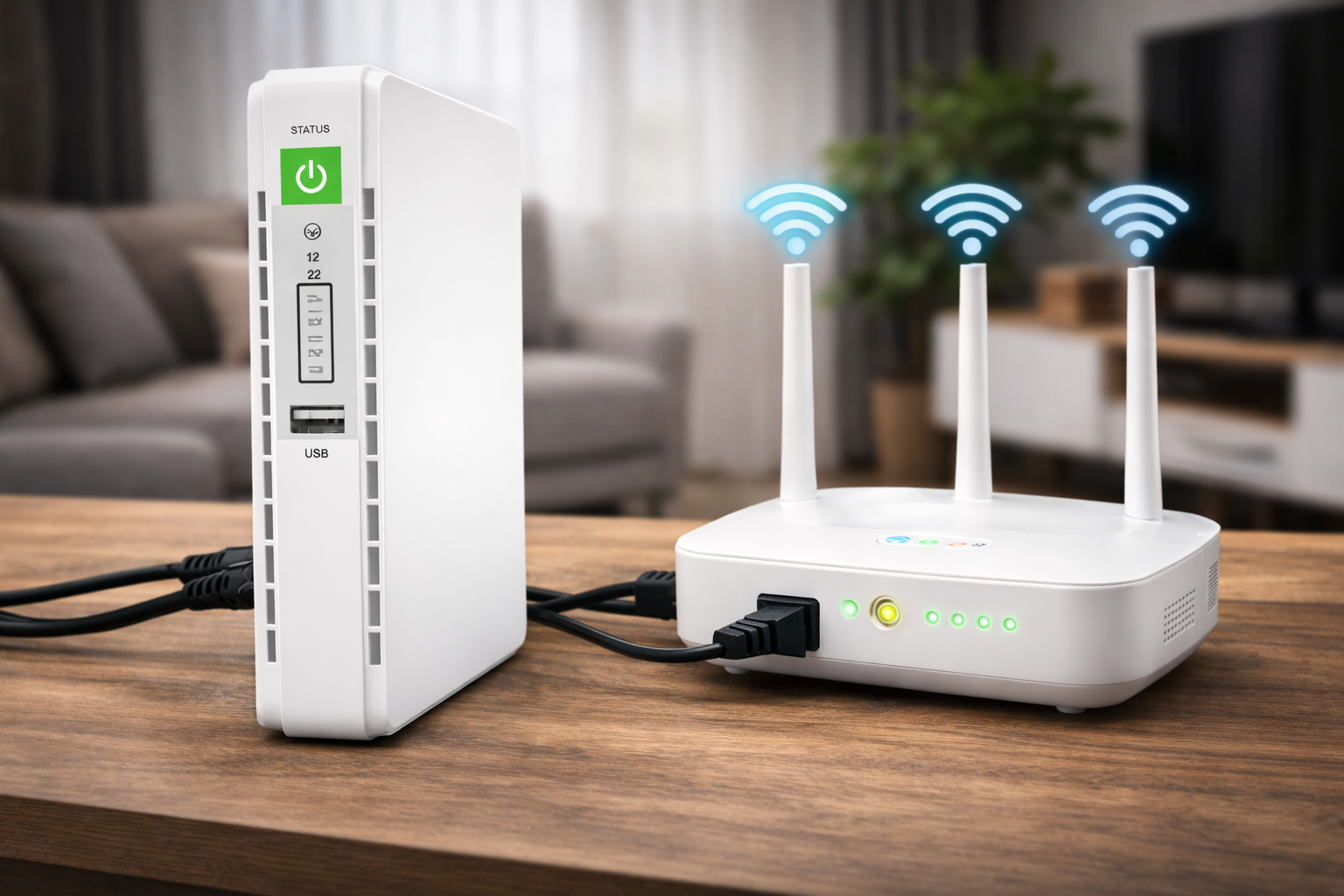
That is why mini UPS devices have become extremely popular. They are small battery backup units designed specifically to keep your router and fiber ONT powered when Eskom electricity goes off.
However, the biggest question people ask before buying one is simple:
How long will a mini UPS actually keep my WiFi running?
The answer is not the same for everyone. Runtime depends on your router’s power usage, the fiber ONT, and the battery size of the UPS itself. In this guide, we explain the real runtime you can expect in South African loadshedding conditions.
What a Mini UPS Actually Powers
A mini UPS does not power your whole house. It is designed only for low-power network devices.
Normally it powers:
• WiFi Router • Fibre ONT (the small fibre box on the wall) • Sometimes a mesh WiFi node
It does NOT power: • TVs • PCs • Gaming consoles • Microwaves
This is important because runtime depends on how many devices you connect.
Typical Power Usage of Fibre Internet Equipment
Most people don’t realize how little electricity their internet equipment uses.
Typical South African fiber setup:
Device
Average Power Use
Fibre ONT
6W – 12W
WiFi Router
8W–18W
Total
14W – 30W
This low usage is exactly why a mini UPS works so well during loadshedding.
How Mini UPS Battery Size Affects Runtime
The most important number on a UPS is mAh (milliamp-hours). This is the battery capacity.
General guideline:
UPS Size
Expected Runtime
8 800 mAh
2–3 hours
10 400 mAh
3–4 hours
15 600 mAh
4–6 hours
20 000 mAh+
6–10 hours
In Stage 4 loadshedding (2-hour outage), almost any decent mini UPS will keep your WiFi on the entire time.
Stage 6 (4-hour outage) requires a higher capacity model.
Real South African Runtime Example
Let’s use a normal home fiber setup:
• 12W router • 8W fibre ONT Total usage = 20W
A 15 600 mAh mini UPS typically runs this setup for about 5 hours.
That means: Stage 2 ✔ Stage 4 ✔ Stage 6 ✔ (most of the time)
This is why mini UPS units are one of the most cost-effective loadshedding solutions in South Africa.
Why Some People Get Only 1 Hour
If your UPS only lasts 1 hour, it is almost always one of these:
You did not connect the fibre ONT (internet still dies)
Wrong voltage cable used
Cheap UPS with fake battery capacity
Too many devices connected (like a TV box)
Mini UPS devices are built specifically for networking equipment—not entertainment systems.
How to Extend Mini UPS Runtime
You can significantly increase runtime by:
• Turning off unused mesh nodes • Disconnecting USB charging ports • Using a low-power router • Charging the UPS fully between outages
Also remember: after multiple loadshedding cycles in one day, runtime becomes shorter because the battery cannot fully recharge.
Can a mini UPS last 4 hours? Yes, but only higher capacity models (around 15 600 mAh or larger). Smaller units may only last 2–3 hours.
Does a mini UPS use a lot of electricity? No. They charge slowly and use less power than most household appliances.
Will a mini UPS damage my router? No. They are specifically designed for routers and provide stable voltage.
Do I need to power the fiber ONT too? Yes. If the ONT is off, your internet will not work even if the router stays on.
Final thought
For most South African households, a mini UPS is the simplest and cheapest way to keep internet working during loadshedding. The actual runtime depends mainly on battery capacity and how many devices you connect, but a good quality unit can easily cover typical Stage 4 outages and often most Stage 6 schedules as well.
South Africa’s loadshedding makes one problem immediately obvious—when the power goes off, your internet goes off too.
For many households, losing WiFi is actually worse than losing lights. Work stops, meetings disconnect, TV streaming ends, and even security cameras stop recording. The good news is you do NOT need a generator or expensive inverter system just to keep your router online.
A mini UPS (uninterruptible power supply) is a small battery backup designed specifically for routers and fiber ONTs. It automatically switches on when electricity cuts and keeps your internet running without you doing anything.
In this guide, we explain which UPS units actually work in South Africa, how long they last during loadshedding, and which one is worth buying.
What is a mini UPS, and how does it work?
A mini UPS is essentially a rechargeable battery pack that sits between your wall plug and your internet equipment. Under normal conditions, it charges itself while powering your router.
The moment Eskom power fails, the device instantly switches to battery power—usually within milliseconds—so your router does not reboot and your fiber connection stays active.
Most homes actually have two devices that need backup power:
The WiFi router
The fibre ONT box (the small box installed by your fibre provider)
If the ONT switches off, your internet dies even if your router stays on. A proper mini UPS powers both devices at the same time.
This is why normal power banks do not work properly—they cannot supply stable continuous power like a UPS can.
How long can a UPS keep your internet on during loadshedding?
This depends on three things:
Battery capacity (measured in mAh or Wh)
Router power usage
Whether it powers the ONT as well
Most fiber routers in South Africa use only 8W to 12W of electricity, which is very low. Because of this, even a small UPS can keep your internet online for 3 to 6 hours.
Typical real-world backup times:
• Small mini UPS (10,000 mAh) → 2–3 hours • Medium UPS (15,000–20,000 mAh) → 4–6 hours • Large mini UPS (25,000 mAh+) → 6–10 hours
This is enough to survive most Stage 2–4 loadshedding cycles.
What to check before buying a Mini UPS in South Africa
Many people buy the wrong UPS and then think UPS devices don’t work. The problem is not the idea—it’s compatibility.
Before you buy a UPS, you must check these 4 things.
1) Voltage (MOST IMPORTANT)
Routers and ONT boxes usually run on 12V or 9V.
If the UPS output voltage does not match your router, it will not power on—or worse, it can damage the device.
Always look at the sticker underneath your router or ONT. You will see something like
Output: 12V—1A
Your UPS must match that voltage.
Good mini UPS units in South Africa normally support:
9V
12V
sometimes 5V USB
Avoid units that only have USB ports—those are power banks, not UPS systems.
2) Number of ports
You need at least 2 DC output ports because loadshedding affects:
• The router • The fibre ONT
Many cheap UPS devices only power the router—then your internet still goes off because the ONT has no power.
This is the number one mistake buyers make.
3) Battery capacity
Capacity determines how long your internet stays on.
Rough guide:
8,000–10,000 mAh → short outages only
15,000–20,000 mAh → ideal for most homes
20,000 mAh+ → best for heavy loadshedding
In South Africa, a 20,000 mAh unit is usually the sweet spot.
4) Automatic switching
A real UPS switches automatically when power cuts.
You should not have to press a button during loadshedding.
If the product description says:
“Manual power on”
Avoid it—it defeats the purpose of a UPS.
Mini UPS vs Generator vs Inverter for WiFi During Loadshedding
Feature
Mini UPS
Power Inverter + Battery
Petrol Generator
Internet stays on instantly
Yes
Yes
No (must start it)
Noise
Silent
Silent
Very loud
Setup difficulty
Plug & play
Medium installation
High
Cost
Low
Medium/High
Medium
Running cost
None
Very low
Fuel required
Works at night
Yes
Yes
Not practical
Powers TV/PC
No
Yes
Yes
Best use
Router + Fibre ONT
Whole room backup
Whole-house emergency
For most South African households, a mini UPS is the easiest and most affordable solution to keep internet working during loadshedding. Inverters and generators can power more appliances, but they are significantly more expensive and require installation or fuel. A UPS is designed specifically for networking equipment and works automatically when the power cuts.
How long will a mini UPS power your router?
Runtime depends on two things: the router power usage and the UPS battery size.
Typical fiber setup:
Fibre ONT: ±8–12W
WiFi Router: ±6–10W
Total load ≈ 15–20 watts.
Estimated runtime:
UPS Capacity
Expected Runtime
8,800 mAh
2–3 hours
10,400 mAh
3–4 hours
20,000 mAh
5–8 hours
This means a properly sized mini UPS can easily cover Stage 2 and Stage 4 loadshedding in South Africa.
Frequently Asked Questions (FAQ)
Can a mini UPS run both my router and fiber box (ONT)?
Yes. Most fiber installations in South Africa have two devices: the fiber ONT and the WiFi router. A properly sized mini UPS is designed specifically for this setup and can power both at the same time. You simply connect both devices to the UPS using the provided DC cables.
How many hours will a mini UPS last during loadshedding?
On average, a standard 10,000 mAh mini UPS will run a router and fiber ONT for around 3–4 hours. Larger models can last up to 6–8 hours depending on the power usage of your router.
Does a UPS damage a router?
No. A mini UPS actually protects your router. It supplies stable voltage and prevents damage caused by sudden power cuts and surges when electricity returns after loadshedding.
Can I use a computer UPS instead?
You can, but it is not ideal. Traditional computer UPS units are designed for PCs and alarms. They are bulky, noisy, and inefficient for routers. A mini DC UPS is quieter, uses less power, and lasts longer during outages.
Do I need an electrician to install a mini UPS?
No. A mini UPS is plug-and-play. You unplug your router power cable, connect it to the UPS, and then plug the UPS into the wall. Setup takes less than 5 minutes.
Will a mini UPS recharge between loadshedding stages?
Yes. Most units recharge within 2–3 hours. This is fast enough to recharge between normal South African loadshedding cycles.
Final Verdict—Is a Mini UPS Worth It?
For most South African households, a mini UPS is one of the simplest and most affordable ways to deal with loadshedding. Instead of installing an expensive inverter or running a noisy generator, a small backup battery can keep your internet connection active automatically whenever the power cuts.
Because routers and fiber ONTs use very little electricity, a properly sized UPS can keep you online for several hours, making it ideal for remote work, online classes, streaming, and security cameras. The one-off cost is low, there is no fuel required, and installation takes only a few minutes.
If staying connected during loadshedding is important to you, a mini UPS is not just a convenience—it is one of the most practical backup solutions you can buy.
Loadshedding has made reliable internet in South Africa a daily challenge. The moment the power goes off, fiber routers and ONT boxes shut down immediately, cutting off work calls, online classes, streaming, and even security cameras.
The problem is that many UPS units sold online are incompatible with South African fiber setups or do not last long enough to survive loadshedding stages. In this guide, we compare the best mini UPS devices available and explain which ones are actually worth buying.
Quick Comparison of the Best Mini UPS Units
UPS Model
What It Powers
Typical Runtime
Biggest Advantage
Who Should Buy It
Gizzu Mini DC UPS (36W)
Router + Fiber ONT
4–6 hours
Reliable all-round compatibility
Most households
UltraLAN Micro UPS
Router + Fiber ONT
3–5 hours
Very stable fiber reconnection
Fiber installations & offices
Volkano Mini UPS – Best Long Runtime
Router + Fiber ONT
6–8 hours
Longest backup time
Work-from-home users
Generic DC Mini UPS (Entry-Level)
Router + Fiber ONT
2–3 hours
Lowest price
Basic internet backup
Entry-level mini UPS units are often sold under different brand names in South Africa, but many share similar internal hardware. They are affordable and suitable for short outages, although runtime and build quality can vary.
Gizzu Mini DC UPS (36W) – Best Overall Choice
The Gizzu Mini DC UPS is one of the most commonly used router backup devices in South Africa and is widely compatible with fiber installations. It supports both 9V and 12V outputs, allowing it to power the fiber ONT and the WiFi router at the same time.
The device automatically switches to battery power when electricity fails, so your internet connection usually stays active without rebooting. For most households, it provides enough backup time to cover a normal loadshedding block depending on the power usage of the router.
Key Features
Powers router and fiber ONT simultaneously
Automatic switchover during outages
Compatible with most ISPs
Compact and easy to install
Pros
Reliable and widely available
Good balance between runtime and price
Suitable for most homes
Cons
Not the longest runtime during extended Stage 6 loadshedding
UltraLAN Micro UPS – Best for Fiber Stability
The UltraLAN Micro UPS is often recommended by fiber installers because of its stable voltage output. A stable power supply helps prevent the ONT from restarting when power returns, which can shorten reconnection time.
It is designed specifically for networking equipment and works well in homes where the fiber connection normally takes long to reconnect after loadshedding. While the runtime is moderate, its reliability makes it a good choice for users who depend on a stable connection for work or online meetings.
Key Features
Stable output designed for fiber equipment
Supports router and ONT
Fast automatic switching
Pros
Reliable connection stability
Good for work-from-home setups
Prevents repeated router restarts
Cons
Runtime slightly shorter than high-capacity units
Volkano Mini UPS (Router & Fiber Backup) – Best Long Runtime
The Volkano Mini UPS is intended for users who need longer backup time than basic entry-level router UPS devices. While mini UPS units all operate on similar principles, models with larger internal batteries generally provide extended runtime when powering a fiber ONT and WiFi router.
In practical home use, runtime depends heavily on the router’s power consumption. Low-power fiber routers can remain online for several hours, while high-performance routers will reduce the backup time. Because of this, a higher-capacity mini UPS can be helpful during repeated loadshedding periods, especially for work-from-home users.
Key Features
Powers router and fiber ONT simultaneously
Automatic switchover during outages
Designed for continuous internet connectivity
Pros
Typically longer runtime than basic units
Suitable for repeated outages
Good for remote work and online meetings
Cons
Still limited compared to a full inverter system
Recharge time required between outages
Generic DC Mini UPS – Best Budget Option
Entry-level mini UPS units are sold under various brand names in South Africa but generally use similar internal hardware. They are designed to power a router and fiber ONT for short outages at a lower cost.
They are suitable for light users who mainly want to keep messaging and basic browsing active during loadshedding. However, runtime and build quality may vary between brands, so expectations should remain modest.
Key Features
Low-cost backup solution
Plug-and-play setup
Works with most routers
Pros
Affordable
Simple installation
Good for short outages
Cons
Shorter runtime
Build quality varies by brand
How to Choose the Right Mini UPS
Choosing the correct UPS is more important than choosing the cheapest one. The wrong model may switch on but still leave your internet offline.
Before buying, check the following:
Voltage compatibility Your router label will show 9V or 12V. The UPS must match it.
Number of ports You need two outputs—one for the router and one for the fiber ONT.
Battery capacity Larger batteries last longer during loadshedding. Homes with frequent outages should consider at least 15,000 mAh.
Automatic switching The UPS must automatically switch to battery when power fails. Manual units defeat the purpose.
Will a Mini UPS Protect Your Router?
Yes. A mini UPS does more than just keep your internet online. It also protects your router and ONT from sudden power loss and power spikes when electricity returns.
Repeated hard shutdowns can shorten the lifespan of networking equipment. Because a UPS provides stable voltage and controlled shutdown behavior, it reduces the risk of damage and improves reliability over time.
How long does a mini UPS last during loadshedding?
This is the most important question before buying a mini UPS. Runtime does not depend only on the UPS itself—it depends on how much electricity your router and fiber ONT use together.
Most fiber setups in South Africa use two devices:
• Fibre ONT (the wall box) → about 6W–10W • WiFi Router → about 8W–15W
That means the average total power usage is around 15W–25W combined.
Because of this low power draw, a mini UPS battery can last much longer than people expect.
Here is a realistic estimate:
Small mini UPS (8 000–10 000 mAh): ± 1 to 2 hours
Medium mini UPS (12 000–15 000 mAh): ± 3 to 4 hours
Large mini UPS (18 000–20 000 mAh): ± 5 to 7 hours
Stage 4 loadshedding is usually 2 hours, while Stage 6 can be 2.5 to 4 hours depending on the schedule. A properly sized mini UPS should therefore be able to keep your internet online for an entire loadshedding block.
Which Mini UPS Should You Choose?
If you are unsure which model fits your situation, the decision mostly depends on how you use your internet during loadshedding.
For most households, the Gizzu Mini DC UPS is the safest choice because it works with the widest range of routers and fiber ONTs.
For work-from-home or online meetings, a higher-capacity unit like the Volkano Mini UPS is useful if outages are frequent.
For stability problems after power returns, the UltraLAN Micro UPS can help prevent connection resets.
For occasional outages only, an entry-level mini UPS is usually enough for messaging and basic browsing.
Choosing the correct UPS is more important than choosing the cheapest one, because compatibility determines whether your internet stays online.
Frequently Asked Questions
Can I install a mini UPS myself? Yes. Setup is simple: unplug the router power cable, connect it to the UPS, then connect the UPS to the wall outlet.
Will fiber reconnect faster with a UPS? Yes. Because the ONT never switches off, the fiber connection does not need to re-establish itself when power returns.
Do mini UPS units use a lot of electricity? No. They use very little electricity because they only charge a small battery and power low-wattage devices.
Is a mini UPS better than an inverter for internet only? Yes. Inverters are designed for many appliances. A mini UPS is cheaper and more efficient if you only want internet backup.
Final Verdict
A mini UPS is one of the most practical solutions for staying connected during loadshedding in South Africa. It requires no installation, no fuel, and works automatically when the power cuts. For most households, a mid-capacity unit around 15,000 mAh offers the best balance between runtime and affordability.
If your main goal is uninterrupted internet for work, school, or security devices, a dedicated router UPS is usually far more convenient than a generator or full inverter system.
Loadshedding has changed how South Africans use electricity at home. Many households now rely on backup power systems, and one of the most common questions is whether everyday appliances—especially kitchen appliances—can still be used when the power goes off.
Air fryers have become extremely popular because they cook quickly and use less electricity than ovens. But during loadshedding, power is limited, and not every appliance is safe to run on an inverter or battery system.
In this guide, we explain exactly whether an air fryer can run on an inverter, what size inverter you need, how long it will run, and when a generator may actually be the better option.
How Much Electricity Does an Air Fryer Use?
Most air fryers in South Africa use between 1,200 watts and 2,000 watts while heating. Smaller basket models usually sit around 1,200W–1,500W, while large family air fryers can reach 1,800W–2,000W.
Unlike a kettle, however, an air fryer does not draw maximum power constantly. It cycles on and off while maintaining temperature. This means the average power usage over time is lower than the rated wattage printed on the box.
Typical real usage:
Small air fryer: about 900W–1,100W average draw
Medium air fryer: about 1,100W–1,400W
Large air fryer: about 1,400W–1,700W
Because of this cycling behavior, an air fryer is actually one of the more inverter-friendly cooking appliances—but only if the inverter is large enough.
Can an Inverter Run an Air Fryer?
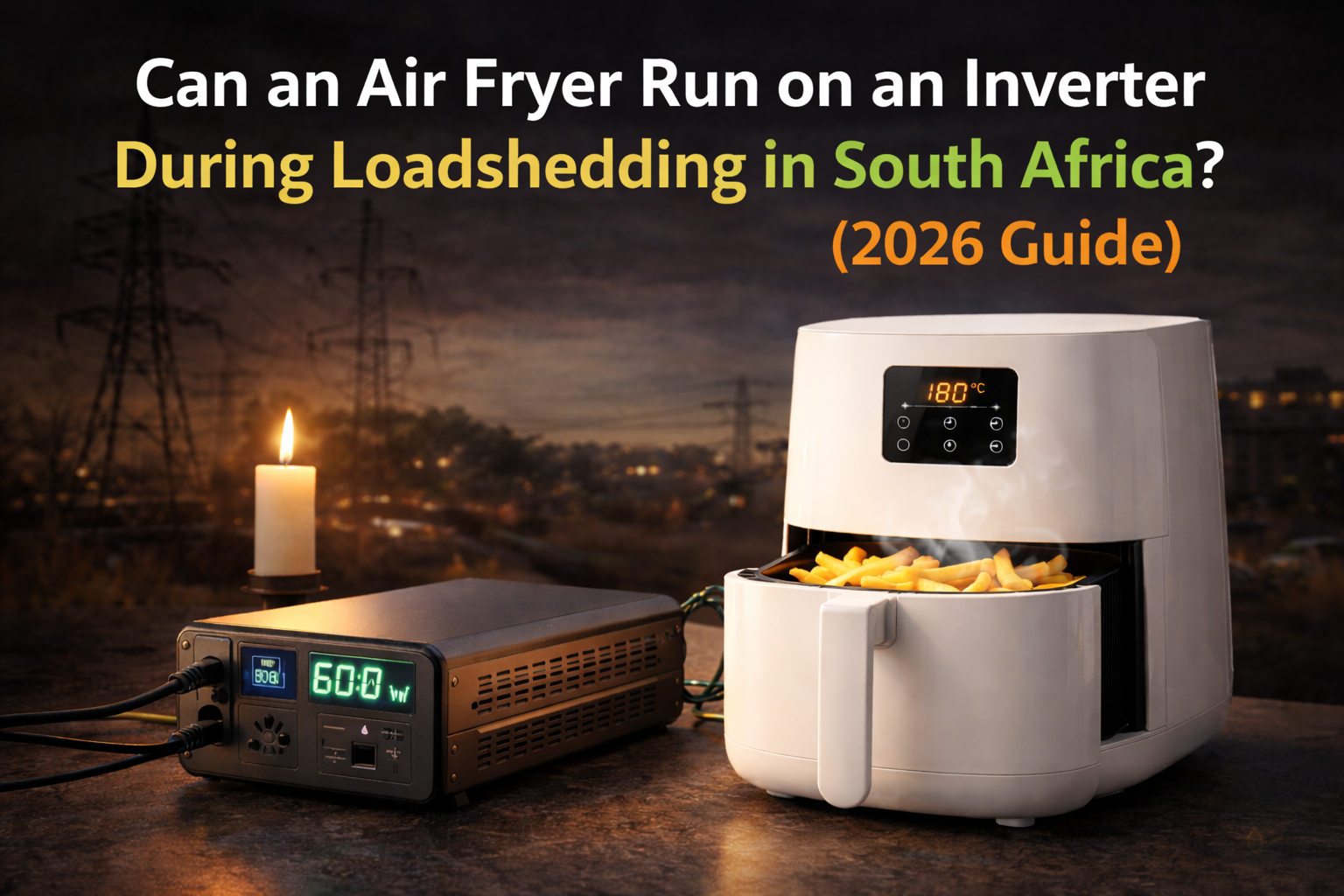
Yes — an air fryer can run on an inverter, but only on a properly sized system.
The biggest mistake homeowners make is assuming any backup power system can run kitchen appliances. Small trolley inverters and mini UPS units are designed for TVs, routers, and laptops. They cannot handle heating appliances.
An air fryer contains a heating element, and heating elements require high wattage. If the inverter is too small, it will either shut down immediately or overload and trip.
As a general rule:
600W – 1000W inverter → ❌ will NOT run an air fryer
1200W inverter → ⚠ sometimes, but risky
2000W pure sine wave inverter → ✅ works properly
The inverter must also be pure sine wave. Modified sine wave inverters may damage the appliance or cause it not to start.
Air Fryer vs Other Backup-Power Appliances During Loadshedding
Appliance
Typical Watt Usage
Works on Small UPS
Works on 2kW Inverter
Best Backup Option
WiFi Router
10W – 20W
Yes
Yes
Mini UPS
TV (LED 55″)
80W – 150W
No
Yes
Inverter
Microwave
1000W – 1500W
No
Sometime
Large Inverter/ Generator
Electric Kettle
2000W – 3000W
No
No
Generator
Air Fryer
1200W – 2000W
No
Yes
Inverter (2 kW+)
How Long Will an Air Fryer Run on a Battery or Inverter?
An inverter does not create electricity—it only uses stored energy from a battery. This means the battery size determines how long you can actually cook.
To understand runtime, we look at battery capacity measured in watt-hours (Wh).
Example: A typical 12V 100Ah battery stores roughly 1200Wh of usable energy (slightly less in real use due to inverter losses).
Now compare that to an air fryer:
A 1500W air fryer running for 20 minutes:
20 minutes = ⅓ hour 1500W × ⅓ hour ≈ 500 Wh used
This means one cooking session already uses nearly half of a standard backup battery.
Typical runtime expectations
Small trolley inverter (single battery) → 1 short cooking session
2 battery system → 1–2 meals
Lithium battery (2–5 kWh) → several meals possible
This is why many households can run lights and TVs for hours, but cooking appliances quickly drain the battery.
Inverter vs Generator: Which Is Better for Running an Air Fryer?
During loadshedding, households normally choose between two backup power options: battery inverters or petrol generators. Both can power appliances, but they behave very differently when used for cooking.
An inverter stores electricity in batteries and supplies quiet, clean power. A generator produces electricity by running a petrol engine.
For short cooking tasks like an air fryer, each option has advantages and disadvantages.
Feature
Inverter
Generator
Noise
Silent
Loud engine noise
Fuel
No fuel required
Requires petrol
Indoor use
Safe indoors
Outdoor use only
Running cost
Very low
Ongoing fuel cost
Air fryer use
Good for short cooking
Good for long cooking
Loadshedding practicality
Very convenient
Reliable but less convenient
In most homes, an inverter is more convenient for quick meals like chips or chicken portions because it starts instantly and is quiet. A generator is better for long cooking sessions or when running multiple high-power appliances at once.
Frequently Asked Questions
Can a mini UPS run an air fryer? No. Mini UPS units are designed for routers and small electronics. An air fryer uses far more power and will immediately overload a mini UPS.
What size inverter do I need for an air fryer? A 2000W pure sine wave inverter is usually the minimum recommended size. Smaller inverters often trip or shut down when the heating element starts.
Will an air fryer damage an inverter? No, as long as the inverter is properly sized and pure sine wave. Problems only occur when the inverter is overloaded.
Is it cheaper to cook with a generator or inverter? For short cooking sessions, an inverter is cheaper because it uses stored battery power. Generators become more practical for long cooking times or multiple appliances.
Can you cook during Stage 6 loadshedding? Yes, if you have a properly sized inverter or generator. Without backup power, no cooking appliances will function during an outage.
Final Verdict
An air fryer can run on an inverter during loadshedding, but only if the system is correctly sized. Small backup units and mini UPS devices are not powerful enough, while a 2 kW or larger pure sine wave inverter can handle short cooking sessions.
For most households, an air fryer is actually one of the more practical cooking appliances during power interruptions because of its short operating time and lower overall energy usage compared to an oven.
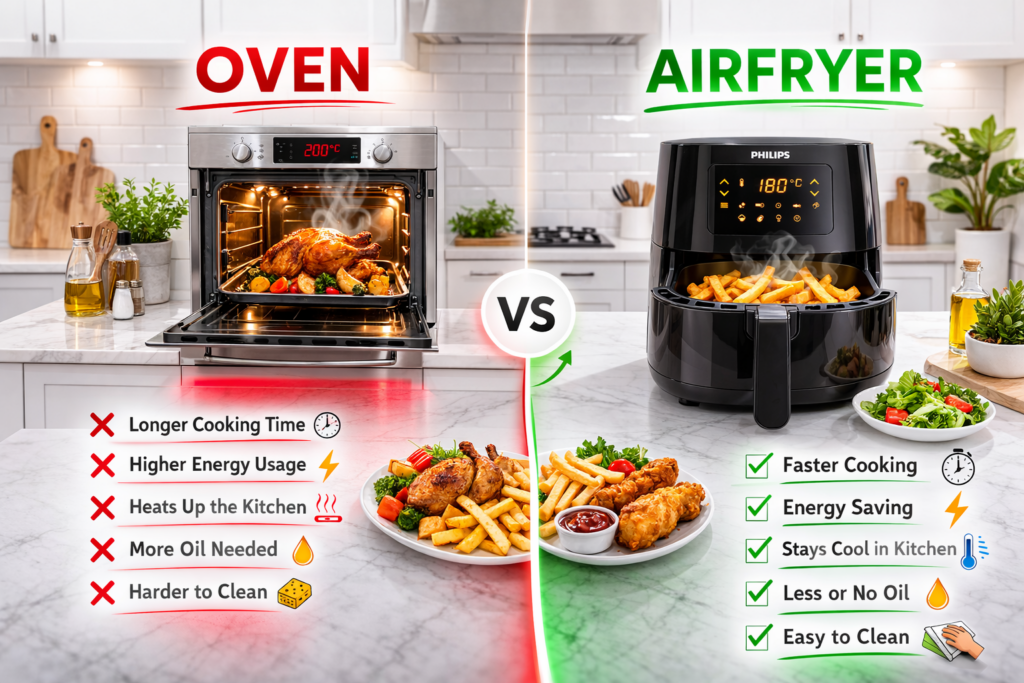
With electricity prices rising and loadshedding still affecting daily life, many South African households are looking for cheaper ways to cook at home. One of the most common questions people ask is whether an air fryer actually uses less electricity than a traditional oven.
Both appliances can cook similar meals, but they operate very differently. In this guide, we compare the real electricity usage of an air fryer vs an oven in South Africa, explain how much each costs to run, and discuss which option is more practical during loadshedding.
A standard electric oven in a South African home generally draws between 2,500W and 3,000W while heating. Before cooking even begins, the oven must preheat, which already consumes a noticeable amount of electricity.
Most meals require 45 minutes to an hour of cooking time, and some dishes need even longer. Because of the high wattage and extended operating time, ovens are among the higher electricity-consuming appliances in the kitchen, especially when used several times a week.
How Much Electricity Does an Air Fryer Use?
Air fryers use a heating element and a high-speed fan to circulate hot air around food. Most models available in South Africa run between about 1,200W and 2,000W depending on size.
Unlike an oven, an air fryer does not need long preheating and usually reaches cooking temperature within a few minutes. Food portions such as chips, chicken strips, and vegetables often cook in 12 to 25 minutes.
Because the cooking time is shorter and the internal space is smaller, the total electricity used per meal is generally lower than that of a traditional oven, even if the air fryer draws similar power while running.
Electricity Cost Comparison (Air Fryer vs Oven in South Africa)
To understand the real difference, it helps to look at electricity usage in practical terms. South African electricity tariffs vary by municipality, but a typical residential rate is roughly around R2.50 to R4.75 per kWh.
A typical oven running at about 2,800W for one hour uses roughly 2.8 kWh of electricity. Depending on the tariff, that single cooking session can cost approximately R7 to R14.
An air fryer using around 1,500W for 20 minutes consumes only about 0.5 kWh. This usually costs about R1.50 to R2.50 per use.
While the exact numbers differ slightly by model and cooking time, the pattern remains consistent: an air fryer generally costs significantly less electricity per meal than a conventional oven.
The differences above show why many South African households now use air fryers for everyday cooking while keeping ovens mainly for baking and large meals.
Air Fryer vs Oven on Backup Power (Inverters & Batteries)
During loadshedding there is no electricity available, so neither an oven nor an air fryer can operate unless a backup power system is being used. Many South African households now rely on inverters or battery systems to keep essential appliances running when power returns or during shorter outages.
A full-sized electric oven usually requires more power than most residential backup systems can safely supply. The heating elements draw high wattage for long periods, which quickly drains batteries or overloads smaller inverters/generators.
An air fryer is generally more practical on backup power. It runs for shorter periods, and, depending on the inverter size, many households can operate it for quick meals after an outage. For homes using battery backup, an air fryer is typically a far more manageable cooking appliance than a traditional oven.
Frequently Asked Questions
Does an air fryer really save electricity compared to an oven? Yes. Although an air fryer still uses a heating element, it cooks food much faster and in a smaller space. Because of the shorter cooking time, the total electricity used per meal is usually lower than a traditional oven.
Can an air fryer run on an inverter in South Africa? It depends on the inverter size. Many medium- to large-sized inverters can run smaller or mid-sized air fryers for short cooking periods, but very small backup systems may struggle to handle the starting power draw.
Why does an oven use more power? An oven heats a much larger internal space and must maintain temperature for a long time. The heating elements repeatedly switch on to keep the temperature steady, which increases electricity consumption.
Is it cheaper to cook chicken in an air fryer? In most cases yes. Chicken portions usually cook in 18–25 minutes in an air fryer compared to much longer cooking times in an oven, reducing overall energy use.
Which appliance is better after loadshedding? After power returns, an air fryer is usually more practical because it heats quickly and prepares meals faster. An oven takes longer to preheat and uses more electricity during the same period.
Final Thoughts
For many South African households, an air fryer is not only convenient but also a practical way to reduce cooking electricity costs. While ovens are still useful for large meals and baking, an air fryer offers faster cooking and lower power usage for everyday meals, especially when managing electricity carefully.
Loadshedding has changed the way South Africans cook at home, and air fryers have quickly become one of the most popular kitchen appliances because they use less electricity than ovens while cooking food faster. The problem is that many people buy the wrong size or a low-quality model and end up with uneven cooking, long cooking times, or a unit that trips an inverter during power outages.
In this guide we compare the best air fryers available in South Africa in 2026, explain what size you actually need, how much power they use, and which models work best during loadshedding so you can choose the right one the first time.
Quick Answer: The Best Air Fryers in South Africa (2026)
If you don’t want to read the full guide, these are the top air fryer choices in South Africa right now based on reliability, cooking performance, electricity usage and value for money:
• Best Overall: Philips Essential XL Air Fryer • Best Budget Option: Bennett Read 4L Digital Air Fryer • Best for Large Families: Milex XXXL 7.2L Air Fryer • Best for Loadshedding/Inverter Use: Xiaomi Smart Air Fryer 3.5L
Below we explain why these models stand out and which one is right for your home.
1. Philips Essential XL Air Fryer – Best Overall Air Fryer in South Africa
The Philips Essential XL Air Fryer is one of the most popular air fryers in South Africa and for good reason. It uses Rapid Air Technology to circulate hot air evenly around food, producing crispy results with little to no oil. The 6.2L capacity is large enough for a family of 4 and makes it ideal for chips, chicken, and frozen foods during loadshedding.
This model is especially attractive to first-time buyers because it is simple to use, heats up quickly, and is far more electricity efficient than a traditional oven. For households affected by frequent loadshedding, the lower power usage makes a noticeable difference on inverter or backup power systems.
Key Features
• ±6.2L capacity (3-4 people: small family size) • Rapid Air Technology for even cooking • Adjustable temperature control • Timer with automatic shut-off • Non-stick removable basket • Easy manual controls
Pros
Very easy to use
Energy efficient
Even cooking results
Good size for families
Trusted Philips reliability
Cons
More expensive than budget brands
No viewing window
Basic digital display
Who should buy the Philips Essential XL Air Fryer?
Live in a flat or small house
Want to reduce electricity usage during loadshedding
Cook for 3-4 people
Want fast meals after work
Ideal for beginners who don’t want complicated settings
2. Milex Power Air Fryer XXL – Best Budget Air Fryer in South Africa
Many South Africans want an air fryer but don’t want to spend premium prices. The Milex Power Air Fryer XXL is one of the most popular budget air fryers because it offers a large basket and strong performance at a much lower price than premium brands.
It is especially popular for students, small families, and first-time buyers who want to try air frying without committing to an expensive appliance.
Key Features
±5.6L capacity (good for 3–4 people)
Adjustable temperature control
30-minute timer
Non-stick removable basket
Manual dial operation (very simple controls)
Pros
Very affordable compared to premium brands
Large basket for the price
Easy to operate
Good results with frozen foods
Widely available in South Africa
Cons
Build quality is average
Louder fan noise than premium air fryers
No automatic cooking programs
Can cook unevenly if basket is overcrowded
Who should buy this air fryer?
The Milex Power Air Fryer XXL is ideal for first-time buyers, students, or households on a budget that still want to reduce electricity usage and cook during loadshedding recovery periods. It offers excellent value for money and is a good starting point before upgrading to a premium model later.
Bennett Read 7.5L Digital Air Fryer – Best for Large Families
For bigger households, basket size becomes very important. The Bennett Read 7.5 L Digital Air Fryer is a popular choice in South Africa because it offers a much larger cooking capacity than standard air fryers while still remaining affordable.
The 7.5-litre basket allows you to cook multiple portions at once, making it useful for families who want to prepare meals quickly without cooking in batches. This is especially helpful during loadshedding recovery periods when electricity is available for a short time and meals need to be prepared fast.
Unlike manual dial air fryers, this model includes digital controls and preset cooking programs, which makes it easier for beginners to get consistent cooking results.
Key Features
Large 7.5L capacity (4-6 people: family sized)
Digital touch screen controls
Multiple cooking presets
Adjustable temperature control
Timer with automatic shut-off
Pros
Large cooking capacity
Easy digital controls
Good for families
Faster meal preparation
Good value for its size
Cons
Takes more counter space
Uses slightly more electricity than smaller models
Not ideal for very small kitchens
Who should buy this air fryer?
The Bennett Read 7.5L Digital Air Fryer is best suited for families of four or more people or households that cook larger meals. It is particularly useful for preparing full dinners quickly during loadshedding breaks.
Xiaomi Mi Smart Air Fryer 3.5L – Best for Small Homes & Inverter Use
The Xiaomi Mi Smart Air Fryer 3.5L has become very popular in South Africa because it combines compact size with modern smart features. Unlike traditional air fryers, this model connects to a mobile app, allowing you to schedule cooking, adjust temperature, and monitor cooking progress remotely.
Its smaller capacity makes it ideal for couples, flats, and apartments where kitchen space is limited. Another advantage is its lower power draw compared to larger air fryers, which makes it one of the more practical options for households using backup batteries or certain inverters during loadshedding recovery periods.
The digital temperature control also allows slower cooking at lower heat settings, which is useful for reheating food, baking, or dehydrating snacks.
Key Features
3.5L compact capacity (1-2 people)
App control via smartphone
Digital temperature control
Timer scheduling
Sleek modern design
Pros
Compact and space-saving
Lower electricity usage than large models
Smart app features
Quiet operation
Good for couples or small kitchens
Cons
Small basket size
Not suitable for large families
Higher price than basic budget models
Who should buy this air fryer?
The Xiaomi Mi Smart Air Fryer is ideal for couples, apartment living, and people who want a modern appliance with smart features. It is also a practical choice for households that rely on backup power because of its smaller energy demand.
Air Fryer Comparison Table (South Africa)
Model
Capacity
Power Usage
Best For
Price Range
Philips Essential XL
6.2L
±2000W
Overall performance
Premium
Milex Power Air Fryer XXL
5.6L
±1700W
Budget buyers
Affordable
Bennett Read 7L Digital
7.5L
±1800W
Families
Mid-range
Xiaomi Mi Smart Air Fryer
3.5L
±1500W
Small homes & inverter use
Mid-range
Note: Air fryer capacity ratings differ between brands. Basket shape and cooking surface area often matter more than the litre number, so two air fryers with similar litre ratings may not cook the same amount of food.
How to Choose the Right Air Fryer in South Africa
Choosing the right air fryer is not only about brand name or price. South African households have unique needs because of rising electricity costs and loadshedding, so it is important to consider a few key factors before buying.if you want to rad more about the top brands in SOuth Africa follow click on the link: What Is the Best Air Fryer Brand in South Africa? (2026)
1. Basket Size
Air fryer capacity is one of the most important decisions.
• 2–3L → Suitable for 1 person • 3–5L → Couples or small families • 5–7L → Families (recommended for most households)
A larger basket allows you to cook full meals at once instead of cooking in batches.
2. Electricity Usage
Power consumption matters, especially if you use backup power. Most air fryers use between 1200W and 2000W.
Smaller air fryers: • Use less electricity • Work better with inverters
Large air fryers: • Cook more food • Use slightly more power
3. Manual vs Digital Controls
Manual dial air fryers: • Cheaper • Simple to operate • Reliable
Digital air fryers: • Preset cooking modes • More precise temperature control • Easier for beginners
4. Cooking Performance
Good air fryers should: • Heat quickly • Cook evenly • Produce crispy results
A stronger fan and proper airflow design are more important than just high wattage.
Many South Africans specifically buy air fryers to cook after loadshedding.
Smaller or mid-size air fryers are usually better for inverter systems because they draw less peak power than ovens.
Air Fryer vs Oven – Which is cheaper in South Africa?
Many South African households are switching to air fryers because of rising electricity costs and loadshedding. While both an oven and an air fryer can cook similar foods, they do not use the same amount of electricity.
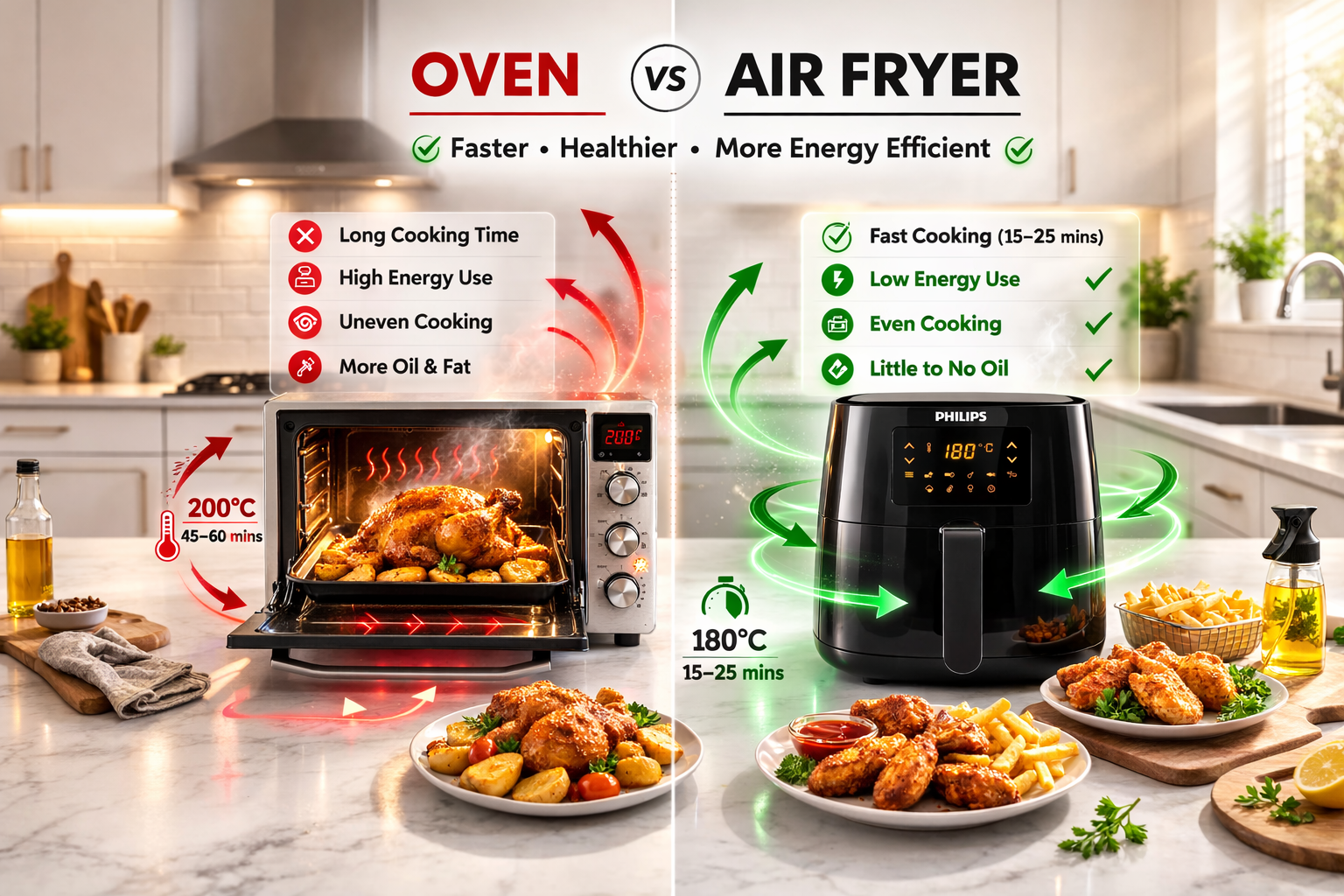
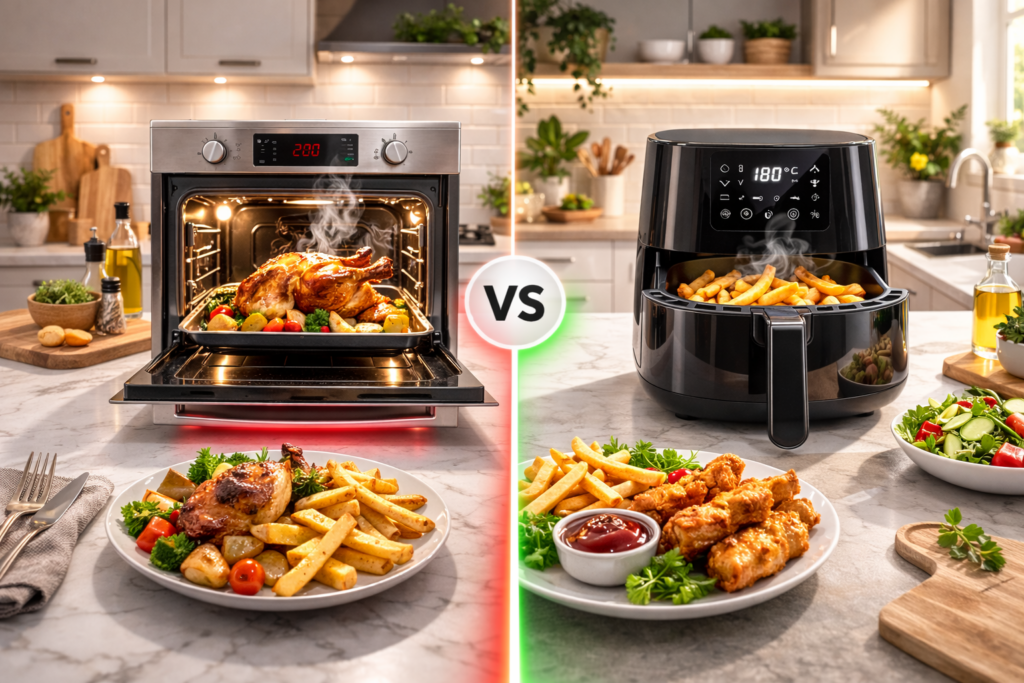
A traditional electric oven normally uses between 2,500W and 3,000W and also needs time to preheat before cooking starts. An air fryer, on the other hand, usually uses 1,200W to 2,000W and begins cooking immediately without preheating. Because cooking times are shorter, the total electricity used per meal is often much lower with an air fryer.
For example, chicken pieces may take 45–60 minutes in an oven, but only about 18–25 minutes in an air fryer. Even though the air fryer still draws power, it runs for a much shorter time, which reduces overall energy usage and monthly electricity costs.
Air fryers are also more practical during loadshedding. Many medium to large inverters can run an air fryer, while most cannot handle a full-size oven. This makes an air fryer a useful option for households using backup power systems.
Overall, for small to medium meals, an air fryer is usually the cheaper and more practical option compared to a traditional oven in South Africa.
Frequently Asked Questions About Air Fryers in South Africa
Does an air fryer use a lot of electricity? No. Most air fryers use between 1200W and 2000W. Because they cook faster than an oven, the total electricity used per meal is usually lower.
Can you run an air fryer during loadshedding? You cannot use it during a power outage, but you can use it on certain backup systems. Medium to large inverters can run many air fryers once power returns, depending on the inverter capacity.
Can an air fryer run on an inverter? Yes, but you usually need at least a 2kW inverter depending on the model.
How long does an air fryer last? Most good brands last 3–5 years with normal use.
Is an air fryer worth it in South Africa? Yes, especially because of loadshedding and rising electricity costs.
Is an air fryer worth it in South Africa? Yes, especially because of loadshedding and rising electricity costs.
What size air fryer do I need? A 3–5L air fryer is suitable for 1–2 people, while a 5–7L air fryer is better for families.
Final Verdict – Is an Air Fryer Worth Buying in South Africa?
Air fryers have become one of the most practical kitchen appliances for South African households. They cook food faster than an oven, use less electricity, and are especially useful after loadshedding when you need to prepare meals quickly.
For most homes, a mid-size air fryer is a good investment because it reduces cooking time and monthly electricity usage while still producing crispy results. Whether you choose a premium model like the Philips, a budget option like the Milex, or a larger family unit, an air fryer is a convenient and cost-effective appliance for everyday cooking in South Africa. Check out: Air fryer vs Oven electricity.
About the author: Tigdag is a South African product review website focused on helping households choose practical appliances for everyday use, especially in situations affected by loadshedding and rising electricity costs. All guides are written to simplify buying decisions and explain real-world usage rather than marketing claims.
Helpful Guides About Air Fryer Electricity & Loadshedding